Australian Outsourced Accounting for Nonprofits: 2026 Guide

Guide to outsourced accounting for nonprofits, featuring a professional working at a desk with financial documents and a calculator.

Nonprofits are the heart of our communities, tackling social challenges and providing vital services that make a lasting impact. Yet, managing their finances can be difficult, especially for organisations operating with limited budgets, evolving compliance obligations, and increased pressure for financial transparency.

This is where outsourced accounting for nonprofits becomes essential. By partnering with experienced accounting professionals, nonprofits can access expert financial management, advanced reporting tools, and consistent compliance oversight without the expense of a full in-house team. 

The right outsourced accounting partner ensures accuracy, accountability, and strategic financial guidance, allowing nonprofits to focus more on their mission and less on managing complex financial operations.

Key Takeaways

  • Outsourced accounting for nonprofits helps organisations manage complex financial, compliance, and reporting obligations without the cost of hiring a full in-house team.
  • Nonprofit-specific requirements such as fund accounting, multi-dimensional expense reporting, and donor-restricted fund management demand specialised expertise that outsourced partners are equipped to deliver.
  • With rising transparency expectations from donors, grantors, auditors, and regulators, outsourcing ensures stronger charity financial reporting, audit readiness, and consistent compliance.
  • The right outsourced accounting partner enables nonprofits to enhance financial accuracy, strengthen stakeholder trust, and redirect more resources toward mission-driven work.

What Makes Nonprofit Accounting Unique?

Before exploring the advantages of outsourced accounting for nonprofits, it’s essential to understand the distinct financial landscape these organisations operate in. 

Unlike for-profit entities driven by shareholder returns, nonprofits focus on maximising social impact and stewarding funds responsibly. They must balance mission delivery with strict transparency and accountability standards set by donors, grant agencies, and regulatory authorities. 

To maintain their tax-exempt status and ongoing public trust, nonprofits must comply with complex reporting and governance requirements, ensuring that every dollar is used ethically and effectively to advance their cause.

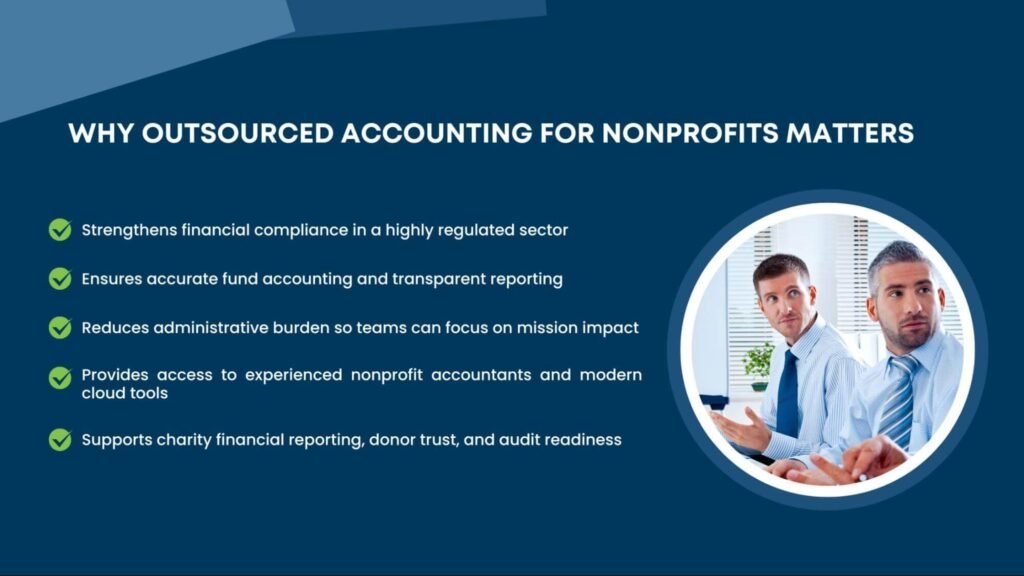
Benefits of outsourced accounting for nonprofits, with professionals collaborating on financial strategies for charity organizations.

Nonprofit Fund Accounting

Fund accounting is a cornerstone of outsourced accounting for nonprofits, ensuring transparency, accountability, and compliance in how financial resources are managed. Unlike traditional accounting, this approach focuses on tracking funds based on donor restrictions and specific program purposes rather than profit generation.

Key elements of fund accounting include:

  • Segregation of resources: Nonprofits divide funds into distinct categories such as unrestricted, temporarily restricted, and permanently restricted, based on donor or grantor requirements.
  • Accurate tracking: Each fund’s income, expenses, and net assets are recorded separately to maintain financial clarity and accountability.
  • Compliance and reporting: Fund accounting ensures adherence to unique charity financial reporting standards and legal obligations for restricted and unrestricted funds.
  • Transparency: Clear records demonstrate that all contributions are used in accordance with donor intent, strengthening public trust.
  • Practical example: A nonprofit may have a general operating fund for daily activities, a restricted fund for a specific grant project, and an endowment fund for long-term sustainability, all managed and reported on independently.

By adopting fund accounting practices, nonprofits can maintain financial integrity, meet reporting obligations, and strengthen stakeholder confidence in their mission-driven work.

Expense Reporting

Accurate expense tracking is a critical component of outsourced accounting for nonprofits, ensuring transparency, compliance, and data-driven decision-making. Nonprofits must often record and report the same expense in multiple ways to meet the needs of different stakeholders, funding bodies, and regulatory agencies.

Nonprofits typically track expenses:

  • By donor restriction or internal designation: To ensure funds are used according to donor intent or board-approved purposes.

  • By grant or major funding source: Many grants and contributions require detailed reporting to verify appropriate fund usage.

  • By functional category: Expenses are classified under programs, general and administrative, or fundraising activities for IRS Form 990 and financial statement reporting.

  • By natural category: Costs are further broken down by type, such as salaries, rent, utilities, travel, and supplies.

  • By department or location: Supports internal budgeting and performance tracking across programs or regions.

  • For indirect cost allocations: Helps distribute shared overhead expenses fairly across different functions or projects.

  • With statistical data and KPIs: Links financial reporting with measurable outcomes, demonstrating impact and accountability to the public.

Because nonprofits may need to classify the same dollar six or more ways, careful planning and a well-structured accounting system, often supported by a specialised accountant for charities, are essential for maintaining accuracy and compliance.

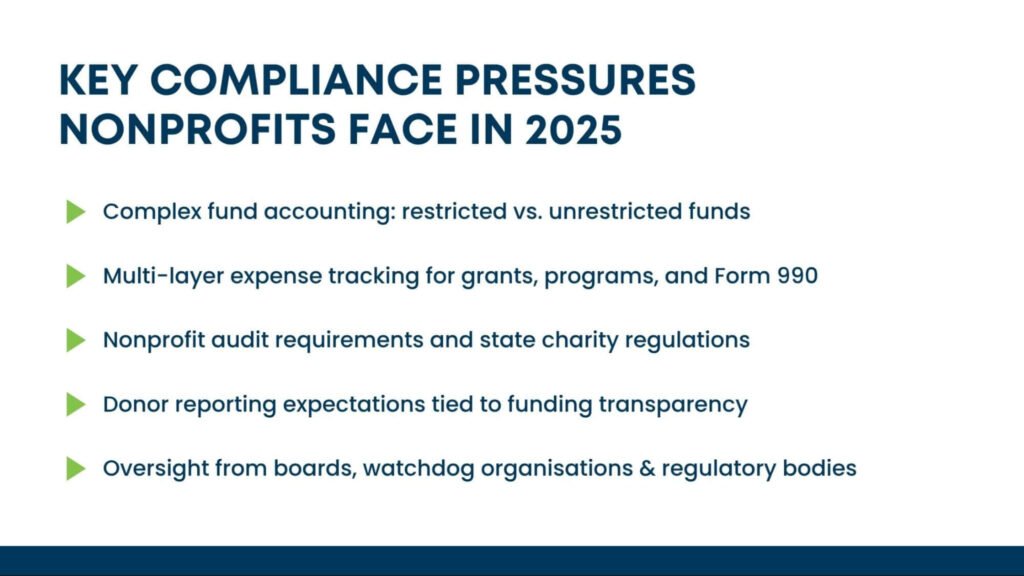
Key compliance pressures nonprofits face in 2025, including fund accounting, grant tracking, audit requirements, and donor reporting.

Compliance and Reporting Challenges

Compliance is one of the most demanding aspects of nonprofit financial management. With evolving regulations and diverse stakeholder expectations, maintaining transparency and accountability has become increasingly complex.

Nonprofits must comply with reporting requirements from multiple key stakeholders, including:

  • The Internal Revenue Service (IRS): To maintain tax-exempt status and ensure accurate completion of Form 990 and related filings.
  • State regulatory bodies: For charitable solicitation and fundraising compliance.
  • Donors and grantors: Who expect detailed charity financial reporting demonstrating fund utilisation and measurable program impact.
  • Board of directors: Responsible for governance, financial oversight, and strategic accountability.
  • Charity watchdog organisations: Such as Charity Navigator, GuideStar, CharityWatch, and BBB Wise Giving Alliance, which assess transparency and stewardship.

Meeting these diverse obligations requires deep knowledge of nonprofit accounting principles, tax laws, and reporting standards. 

For many smaller organisations, maintaining this expertise internally is resource-intensive, making nonprofit accounting outsourcing a cost-effective and compliant alternative.

Choosing the Right Outsourced Accounting Partner

Selecting the right provider for outsourced accounting for nonprofits is crucial to ensuring both financial efficiency and long-term compliance. 

The right partnership can empower your organisation to focus on its mission while maintaining transparency and control over its finances.

When evaluating potential partners, consider the following:

  • Nonprofit expertise: Choose firms with a proven track record in the nonprofit sector. For instance, BPM has served more than 500 nonprofit organisations over four decades, providing deep sector insight and practical experience.
  • Technology capabilities: Ensure they use modern, cloud-based tools such as QuickBooks, Sage Intacct, or NetSuite platforms well-suited to nonprofit accounting and reporting needs.
  • Customisation: Look for flexibility in services that can be tailored to your organisation’s structure, size, and financial complexity.
  • Communication style: Select a team that aligns with your preferred communication frequency and reporting approach.
  • Compliance knowledge: Confirm their understanding of nonprofit accounting standards, audit preparation, and relevant certifications like the AICPA Not-for-Profit Certificate.

Partnering with a firm like NCS Australia, a trusted outsourcing company offering comprehensive financial services compliance outsourcing, can help nonprofits enhance accuracy, strengthen compliance, and channel more resources toward community impact.

Conclusion

In 2025, outsourced accounting for nonprofits has become more than just a financial solution, it’s a strategic step toward sustainability, compliance, and transparency. 

As reporting standards grow more complex, outsourcing enables nonprofits to access specialised expertise and advanced tools that ensure accuracy and accountability in every financial decision.

By leveraging outsourced bookkeeping for nonprofits and reliable accounting packages for charities, organisations can simplify charity financial reporting, meet nonprofit audit requirements, and dedicate more time to their mission. 

A trusted accounting partner empowers nonprofits to strengthen governance, build donor confidence, and focus their energy where it matters most, creating lasting community impact.

Get to Know NCS Australia

Accurate, compliant, and affordable bookkeeping services for Australian businesses – managed by certified experts.

How to File Business Activity Statement (BAS) in 2025-26

Business professionals reviewing financial documents on a tablet for filing a Business Activity Statement (BAS).

If your organisation has an ABN and is registered for GST, the ATO will automatically issue your Business Activity Statement for each reporting cycle, monthly or quarterly, depending on your requirements. Understanding how to file a business activity statement is essential for nonprofits in 2025, especially with strict accuracy standards and firm lodgement deadlines.

Even small errors can create delays, penalties, or compliance risks, making it crucial to maintain clean financial records and stay audit-ready. Whether your BAS is prepared internally or through an outsourced accounting partner, knowing the requirements supports smoother operations and allows you to focus more on community outcomes.

Key Takeaways

  • Understanding how to file a Business Activity Statement (BAS) is essential for nonprofits to maintain compliance, avoid penalties, and ensure accurate financial reporting.

  • Each BAS is customised based on your organisation’s GST status, PAYG obligations, and other tax registrations like FBT, LCT, WET, and Fuel Tax Credits.

  • Lodgement frequency, annual, quarterly, or monthly, depends on your turnover, making it important to track ATO BAS due dates to avoid missed deadlines.

  • Working with a registered BAS or tax agent helps reduce errors, improve compliance accuracy, and ensure smooth, stress-free lodgement.

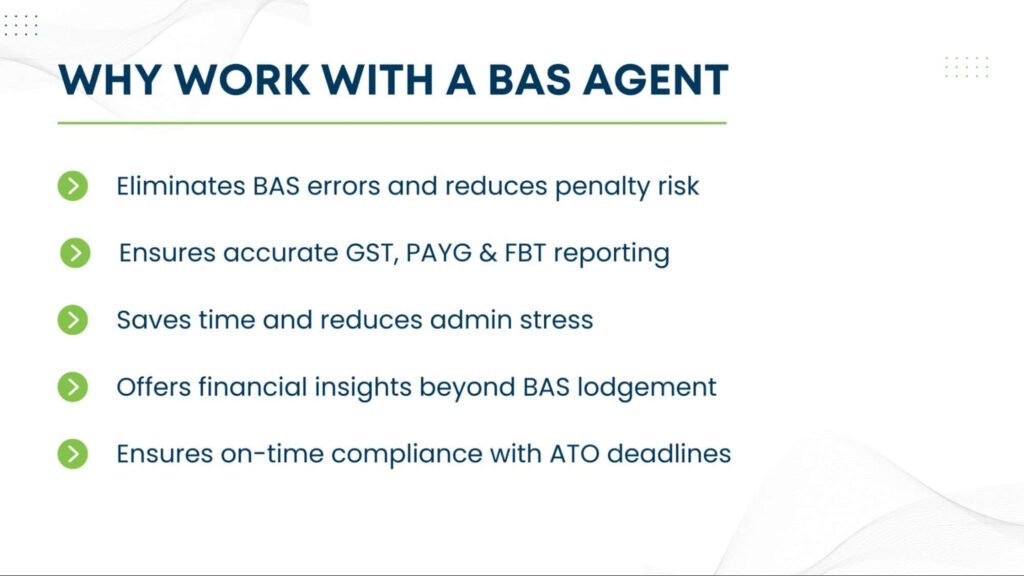
Bullet points explaining the advantages of working with a BAS agent for accurate GST and PAYG reporting.

Understanding Your Business Activity Statement: A Complete Compliance Guide

The Business Activity Statement (BAS) is not a generic tax form but a customised reporting tool designed to reflect your organisation’s specific financial activities. Understanding how to file a business activity statement helps you interpret this document clearly, ensuring you meet your obligations with accuracy and confidence. 

Your BAS will vary based on your size, structure, and tax registrations, making it essential to know which components apply to your operations and when to lodge business activity statement submissions to stay fully compliant.

Key Components You May Find on Your BAS:

  • Goods and Services Tax (GST)
  • Pay-As-You-Go (PAYG) Instalments
  • PAYG Withholding
  • Fringe Benefits Tax (FBT)
  • Wine Equalisation Tax (WET)
  • Luxury Car Tax (LCT)
  • Fuel Tax Credits (FTC)

Goods and Services Tax (GST)

GST is a 10% consumption tax applied to most goods and services sold or consumed in Australia. Organisations that exceed the $75,000 turnover threshold ($150,000 for nonprofits) must register for GST, while others may opt in voluntarily to improve transparency and claim credits. For many nonprofits, annual GST reporting is an option where eligible, simplifying compliance in a low-activity year.

Key GST obligations include:

  • Registering once your turnover exceeds the threshold
  • Charging 10% GST on taxable sales
  • Tracking all GST credits from business purchases
  • Keeping accurate GST records
  • Reporting GST collected and paid on your BAS

Pay-As-You-Go (PAYG)

PAYG helps organisations spread income tax payments throughout the year. It includes two components: instalments and withholding.

PAYG Instalments

These are periodic prepayments toward your expected annual tax. They:

  • Begin after your first profitable tax return
  • Offset your year-end tax liability
  • Are calculated based on your previous taxable income

PAYG Withholding

If you pay wages, you must register for PAYG withholding. You must:

  • Withhold the correct tax from employee salaries
  • Report gross wages and withheld tax on your BAS
  • Remit those amounts to the ATO

Fringe Benefits Tax (FBT)

Fringe Benefits Tax (FBT) is a separate tax paid by employers on non-cash benefits provided to employees in addition to their salary or wages. If your organisation offers perks such as company cars, entertainment, or expense reimbursements, any FBT payable for the reporting period must be included in your BAS. 

Although FBT is calculated independently from GST or income tax, businesses may still need to report instalments or their FBT liability through their BAS, making it essential to track and determine the taxable value of all fringe benefits provided.

Key points to remember about FBT:

  • Applies to non-cash benefits provided to employees
  • Calculated separately from income tax
  • Based on the taxable value of fringe benefits
  • Reported as part of your Business Activity Statement

For support in meeting complex compliance requirements across FBT and GST, many nonprofits partner with financial services compliance specialists.

Luxury Car Tax (LCT)

Luxury Car Tax (LCT) is a federal tax applied to the sale or importation of high-value vehicles that exceed the ATO’s annual luxury car threshold. 

While it mainly affects car dealers, importers, and individuals purchasing prestige vehicles, any business involved in selling or importing eligible cars must calculate and report LCT through their BAS.

The tax is only applied to the portion of the vehicle’s value that exceeds the set threshold, making accurate valuation and record-keeping essential for compliance.

Key points to know about LCT:

  • A 33% tax is applied to the value of a car above the luxury car threshold
  • Applies to licensed dealers and individual importers of luxury vehicles
  • 2023–24 thresholds: $89,332 for fuel-efficient vehicles and $76,950 for other vehicles
  • 2024–25 thresholds: $91,387 for fuel-efficient vehicles and $80,567 for other vehicles
  • Calculated only on the amount exceeding the threshold
  • Must be reported on the BAS when selling or importing eligible vehicles

Wine Equalisation Tax (WET)

  • Applies only to wine manufacturers, wholesalers, and importers
  • Tax rate: 29% of the value of the wine
  • Calculated and reported through your Business Activity Statement (BAS)
  • Requires detailed record-keeping of all wine sales and valuations

Fuel Tax Credits (FTC)

  • Available for machinery, heavy vehicles, and off-road business vehicles
  • Claimed as a credit on your BAS to offset fuel excise
  • Must calculate the eligible fuel used for business activities
  • Requires accurate documentation of fuel purchases, usage, and business purposes
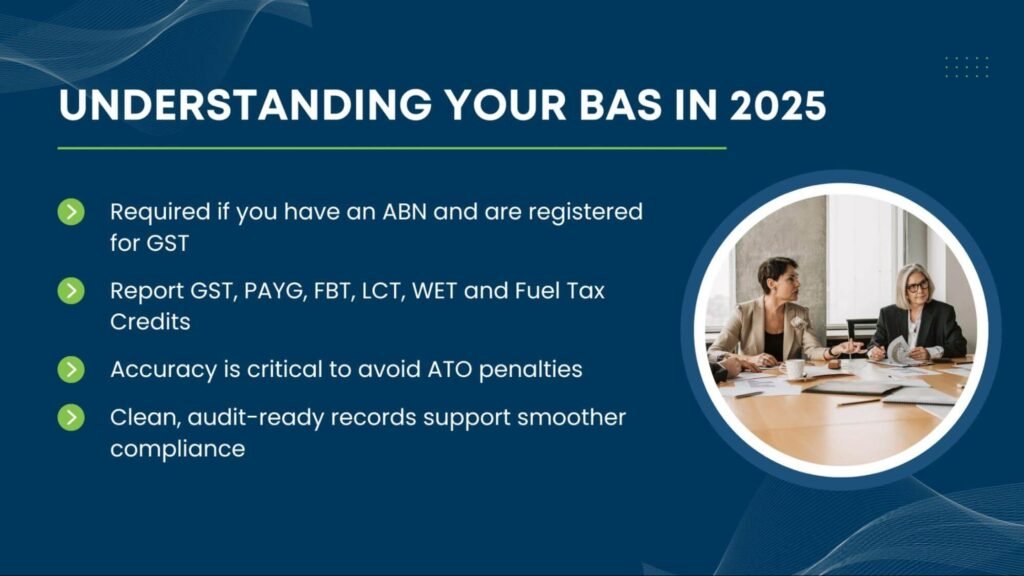
Team meeting discussing GST and tax reporting requirements for BAS in 2025.

How Often Do I Need to Lodge My BAS?

If you’re registered for GST, you must lodge a BAS every reporting cycle, even if you have no activity.

Annual

  • For businesses under $75,000 turnover ($150,000 for nonprofits)

Quarterly

  • For organisations with a turnover under $20 million

Quarterly Due Dates:

  • Q1 (Jul–Sep): 28 October
  • Q2 (Oct–Dec): 28 February
  • Q3 (Jan–Mar): 28 April
  • Q4 (Apr–Jun): 28 July

Monthly

  • Required for turnover above $20 million
  • Due 21 days after the month-end

(Note: always check current ATO BAS lodgement dates, tax agent guidance if you use a registered agent to ensure agent-specific concessions are applied.)

How to File a Business Activity Statement

You can file your BAS through:

  • Your myGov account (sole traders and individuals)
  • ATO Online Services for Business
  • A registered BAS or tax agent, many organisations choose this route to lodge business activity statement submissions correctly and on time

When lodging yourself, accuracy is essential. You must calculate:

  • GST
  • PAYG withholding
  • PAYG instalments
  • Any additional taxes (FBT, FTC, LCT, etc.)

A single miscalculation can trigger ATO penalties.

How to prepare a BAS statement

Before lodging, gather:

  • Sales records
  • Purchase invoices
  • Payroll summaries
  • Reconciled bank statements

Why Use Professional BAS Support

Many nonprofits choose a registered BAS agent because professionals:

  • Detect errors you may miss
  • Interpret tax requirements correctly
  • Ensure on-time, accurate lodgement
  • Reduce penalty risk
  • Free your organisation’s time
  • Provide additional financial insights

Why ATO BAS Due Dates Matter for Your Business

Understanding your ATO BAS due dates is more than just ticking a compliance box, it’s essential for avoiding penalties, maintaining cash-flow stability, and ensuring your records remain accurate throughout the year. 

When you prepare BAS statements correctly and ahead of time, you give your business the financial visibility it needs to plan tax payments and manage expenses. 

Many businesses work with an ATO BAS lodgement dates tax agent to avoid confusion around quarterly and annual deadlines, especially when juggling payroll, GST, PAYG, and other tax obligations.

Conclusion

Lodging your BAS doesn’t have to be overwhelming. With the right preparation and clear understanding of your obligations, you can manage your Business Activity Statement with confidence and avoid unnecessary stress. 

And if you ever find the process too complex, working with a professional can make BAS lodgement smoother, more accurate, and fully aligned with your responsibilities. 

Whether you choose to lodge yourself or rely on expert support, staying proactive ensures your business remains compliant and on track with its financial goals, especially when keeping up with changing ATO BAS due dates.

Payday Super Reform for Employers | 2026 Compliance Changes

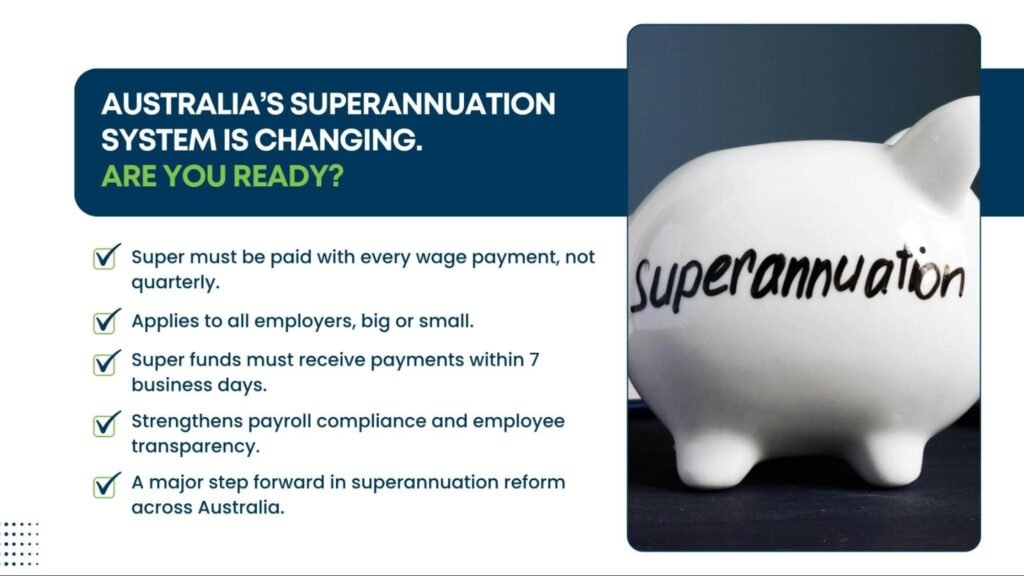
Payday super reform for employers with 2026 compliance updates

The upcoming payday super reform for employers is set to reshape how businesses handle superannuation payments. The Federal Government has introduced new legislation that ties superannuation contributions directly to each pay cycle, a landmark superannuation reform that could replace the traditional quarterly payment model. 

Introduced to Parliament on 9 October 2025, the bill is progressing quickly, signalling the government’s intent to strengthen payroll compliance and ensure employees receive their super in real time.

If passed, the Payday Super Changes 2026 will require employers to pay super at the same time as wages from 1 July 2026. For business owners, this shift presents both a compliance test and a chance to modernise systems, streamline reporting, and better meet their employer obligations.

While the super guarantee changes in 2026 will demand operational adjustments, they also open the door for more transparent, technology-enabled payroll processes that strengthen trust and accountability in the workplace.

Key Takeaways

  • From 1 July 2026, Australian businesses must issue 30% of invoices electronically via the Peppol e-Invoicing standard.
  • The ATO’s compliance focus will expand to include real-time digital record-keeping and e-invoicing adoption monitoring.
  • GST, payroll, and BAS reporting will move toward increased automation and data pre-filling to reduce manual errors.
  • Businesses that digitally transform early will benefit from smoother ATO integration, faster payments, and reduced compliance costs.

What’s Changing in 2026: New Compliance Rules

Under the Payday Super Reform for employers, several key updates will reshape how businesses manage superannuation contributions:

  • Super must be paid with wages: Employers will be required to pay super at the same time they process payroll, whether that’s weekly, fortnightly, or monthly.
  • Funds must reach accounts within 7 business days: Contributions must arrive in employees’ super funds within seven business days of payday, not just be lodged or processed.
  • Applies to all employers: The super guarantee changes 2026 apply uniformly, whether your business employs two people or two hundred.
  • Aligns with modern payroll compliance: Think of it as moving from quarterly instalments to real-time reporting, similar to PAYG withholding, only this time, it’s for super.

These Payday Super changes 2026 aim to strengthen employer obligations, reduce unpaid super risks, and improve payroll visibility across the economy. Businesses using outsourced payroll services can benefit from automated remittance features that simplify real-time super payments.

The Purpose Behind the Payday Super Reform

The payday super reform for employers is being introduced to address long-standing issues in Australia’s superannuation reform framework. Here’s why the change is happening:

  • $5.2 billion in unpaid super each year: Treasury data shows that around $5.2 billion in superannuation contributions go unpaid annually across the economy.


  • Causes of non-payment: These shortfalls often stem from cash flow challenges, administrative errors, or business distress, especially under the quarterly payment model.


  • Visibility gap for employees: Under current rules, employees might work up to three months before discovering missed super payments, making problems harder to fix.


  • Real-time transparency: With payday super changes 2026, contributions flow alongside wages, helping employers detect and resolve issues within days instead of months.


  • Fair competition: The reform ensures that compliant businesses aren’t disadvantaged by competitors who delay payments, strengthening overall payroll compliance and employer obligations.

In short, these super guarantee changes 2026 aim to build a fairer, more transparent system that benefits both employers and employees while safeguarding Australia’s retirement savings.

Australia superannuation system changes and employer readiness checklist

2026 Compliance Changes: What Employers Need to Know

Here’s a point-wise summary of all key updates under the payday super reform for employers, effective 1 July 2026:

Category Key Change Impact on Employers
Super Payment & Timing Rules Super must be paid on payday Employers must pay superannuation contributions at the same time as employee wages, ending the quarterly payment model.
Funds must reach super accounts within 7 calendar days Payments must clear into employees’ super funds within seven days of payday, not just be processed.
Applies to all employers Whether you employ two people or two hundred, the Payday Super Changes 2026 apply equally across all businesses.
Regulatory & Reporting Changes ATO monitoring via Single Touch Payroll (STP) The ATO will use real-time payroll data to detect missed or late payments faster, improving payroll compliance.
New definition of “qualifying earnings” Clarifies what types of income count toward the Super Guarantee changes 2026, improving calculation accuracy.
Retirement of Small Business Superannuation Clearing House (SBSCH) From July 2026, small employers must use approved digital systems to make direct super payments.
Penalty & Enforcement Updates Stronger Superannuation Guarantee Charge (SGC) regime Late or unpaid contributions may attract higher penalties and interest, reaching up to 60% in some cases.
Tighter voluntary disclosure rules Employers who self-correct errors early may face reduced penalties compared to those identified through audits.
Payroll & Cash Flow Implications Integration with payroll systems Employers must update payroll software to handle frequent super payments and ensure automation accuracy.
Impact on cash flow Transitioning from quarterly to per-pay-run payments shortens cash cycles, businesses must plan for liquidity.
Forecasting & budgeting adjustments Firms should review cash flow models to align with the new payment frequency and maintain consistent financial health.

Strategic Takeaway: Preparing Your Business for the 2026 Compliance Shift

The superannuation reform marks a major shift in employer obligations and payroll compliance. By preparing early, upgrading payroll systems, forecasting cash flow, and testing real-time payment, businesses can turn these super guarantee changes 2026 into an opportunity for greater transparency, efficiency, and trust.

How the Payday Super Reform Affects Business Cash Flow

The payday super reform for employers won’t change how much you pay, the superannuation guarantee rate remains at 11.5%, but it will significantly change when you pay it. 

Under the new rules, payments must be made within days of payroll processing rather than months later. This shift demands better cash flow forecasting and financial planning. Businesses that use outsourced bookkeeping services or cloud-based accounting solutions can manage this transition more smoothly.

Here’s how to prepare for the payday super changes 2026:

  • Review your current payroll process: If you already set aside super each pay run, you’re ahead of the curve.


  • Plan for tighter cash cycles: Businesses that rely on the full quarterly window will need to realign cash flow planning and liquidity management.


  • Start transitioning early: From January 2026, consider shifting to monthly or fortnightly payments. This six-month lead time allows you to test processes, assess cash flow impact, and fine-tune your systems before compliance becomes mandatory.


  • Adopt automation: Integrate payroll with real-time payment and financial compliance outsourcing to reduce manual errors.

Ultimately, this superannuation reform is an opportunity to strengthen financial discipline. By embedding super payments into your regular payroll cycle now, you’ll make the transition smoother and future-proof your business operations.

Conclusion: Preparing for the 2026 Payday Super Era

The Payday Super Reform for Employers marks a defining moment in Australia’s payroll compliance landscape. From 1 July 2026, employers will need to move beyond quarterly payments and adopt real-time super contributions to meet new legal standards. 

While the transition may initially challenge existing payroll processes, it also presents an opportunity to modernise systems, improve cash flow visibility, and strengthen employee trust.

Forward-thinking businesses that upgrade their payroll software, integrate STP-enabled systems, and review cash management cycles early will be best positioned to meet the reform head-on. 

If your business needs guidance on aligning payroll processes or adopting automation for real-time compliance, contact our team today. By acting now, employers can turn compliance into a strategic advantage, ensuring accuracy, transparency, and long-term financial resilience in Australia’s new superannuation era.

Top Outsourcing Mistakes in SMSF Administration and How to Avoid Them

Team discussing strategies to avoid mistakes in SMSF administration outsourcing

Self-Managed Super Funds (SMSFs) are becoming increasingly popular in Australia as they provide greater control and flexibility over retirement savings. However, this independence also brings significant responsibility, particularly around compliance with strict Australian Taxation Office (ATO) regulations. 

Trustees must maintain strong governance, make sound investment decisions, and ensure full compliance at all times, a task that can quickly become overwhelming.

With the ATO reporting over 27,000 SMSF contraventions in the 2023–24 financial year, many trustees unknowingly fall into avoidable errors that lead to penalties, loss of tax benefits, and administrative stress. 

This blog, presented by NCS Australia, a trusted outsourcing company, highlights the top outsourcing mistakes in SMSF administration and how the right outsourcing support can strengthen compliance, streamline administration, and protect long-term retirement wealth.

The Most Common Outsourcing Mistakes in SMSF Administration

Before exploring solutions, it’s important to understand the frequent SMSF administration errors trustees make when managing their fund. 

These issues often arise due to limited expertise, operational gaps, and risk and compliance mistakes across record-keeping, reporting, or governance processes. 

In the sections ahead, we uncover the most common pitfalls and how engaging expert SMSF outsourcing services can effectively prevent them and strengthen compliance.

1. Delayed or Late Lodgement of SMSF Returns

Timely lodgement of SMSF annual returns is critical to maintaining compliance with ATO regulations. However, many trustees overlook key deadlines or struggle to manage documentation efficiently, resulting in late submissions. 

Such delays not only attract penalties but can also increase regulatory scrutiny, placing the fund’s compliance status at risk.

How Outsourcing Services Add Value:

  • Ensures accurate preparation and timely lodgement of all SMSF annual returns and required documentation.
  • Provides structured workflows and compliance-driven processes to avoid oversight or SMSF outsourcing administration errors.
  • Offers automated reminders and deadline tracking to prevent delays and missed lodgements.
  • Strengthens compliance risk management and helps maintain a clean lodgement history with the ATO.

2. Inaccurate or Incomplete Financial Reporting

Accurate financial reporting is a critical part of SMSF record management, requiring alignment across financial statements, tax returns, and supporting documents. When reports contain inconsistencies or errors, it can result in audit failures, SMSF compliance risks, and potential legal consequences for trustees.

How Outsourcing Services Add Value:

  • Ensures precise record-keeping and accurate financial statements in line with SMSF compliance standards.
  • Provides access to qualified accounting professionals who manage tax calculations and financial reporting with expert oversight.
  • Minimises reporting errors through quality checks and review processes performed by experienced SMSF specialists.

3. Outdated or Incorrect Trust Deeds

Trustees must ensure that the SMSF trust deed is current and aligned with legislative requirements. As superannuation laws evolve, trust deeds must be reviewed and updated to reflect regulatory changes. Failure to do so can limit fund operations, cause compliance breaches, or impact audit outcomes.

How Outsourcing Services Add Value:

  • Professional SMSF experts monitor legislative changes and recommend timely trust deed updates.
  • Reduces audit risks by ensuring all deed amendments are correctly managed and documented.

4. Incorrect Asset Ownership and Setup

All SMSF assets must be registered correctly in the name of the fund, not in the name of individual members. Errors such as bank accounts or investments incorrectly held under member names can lead to breaches and audit complications.

How Outsourcing Services Add Value:

  • Ensures proper asset setup and correct ownership structure under the SMSF entity.
  • Provides professional guidance to rectify documentation errors and maintain compliant asset registers.

Many trustees complement their SMSF oversight with expert virtual CFO services to monitor asset allocations, cash flow, and investment performance throughout the year.

5. Non-Compliant Investment Decisions

SMSFs must adhere to the ATO’s investment rules, including diversification and the sole purpose test. According to ASIC’s 2024 SMSF Report, one in four trustees failed to meet investment diversification requirements, exposing funds to unnecessary risk.

How Outsourcing Services Add Value:

  • Provides access to SMSF investment and strategy experts for compliant investment decisions.
  • Reviews and monitors transactions to ensure alignment with ATO investment rules.

If trustees need broader back-office help, engaging outsourced bookkeeping services can ensure that every transaction, record, and report aligns with SMSF and ATO compliance standards.

6. Missing Minimum Pension Payments

Once members enter the pension phase, they must withdraw the minimum annual pension amount required by the ATO. Missing this requirement can result in tax penalties and loss of tax-free pension benefits.

How Outsourcing Services Add Value:

  • Specialists calculate and track minimum pension withdrawals for each member.
  • Automated reminders ensure timely pension payments and full compliance.

7. Inadequate Record-Keeping and Documentation

Poor documentation of trust deeds, investment strategies, financial statements, and meeting minutes is a common cause of audit non-compliance. Incomplete records make it difficult to justify fund decisions and may lead to ATO penalties.

How Outsourcing Services Add Value:

  • Establishes strong record-keeping systems that maintain accurate and accessible SMSF documentation.
  • Provides secure digital and cloud-based storage for easy access to historical records during audits.

8. Failure to Conduct Independent Audits

SMSFs must undergo an annual audit by an independent ASIC-registered SMSF auditor. Missing or delaying audits can result in penalties and potential trustee disqualification.

How Outsourcing Services Add Value:

  • Secures access to approved and independent SMSF auditors for annual compliance.
  • Prepares reports to audit-ready standards, reducing compliance breaches and audit-related risks.

The Benefits of Outsourcing SMSF Services

Outsourcing SMSF administration provides strategic advantages through specialist guidance, compliance expertise, and robust fund management.

Key Advantages:

Expertise & Accuracy: Access to skilled SMSF professionals with deep compliance knowledge and precision-driven reporting.

Time Efficiency: Reduces administrative burden, allowing trustees to focus on strategic investment decisions.

Risk Mitigation: Minimises compliance risks and prevents avoidable errors that trigger penalties or ATO scrutiny.

Cost-Effective: Removes the need for in-house resources, costly software, and ongoing compliance training.

Continuous Regulatory Updates: Trustees receive timely ATO and superannuation law updates to ensure ongoing compliance.

Since SMSF regulations evolve frequently, trustees must stay updated with every ATO change or engage expert SMSF administration services providers who monitor regulatory shifts and ensure full compliance at all times.

Conclusion

Managing an SMSF requires discipline, precision, and a deep understanding of regulatory obligations. As outlined in this guide, many outsourcing mistakes in SMSF administration occur when trustees attempt to manage compliance, reporting, and auditing responsibilities independently, leading to avoidable penalties, lost tax concessions, and increased stress.

By partnering with trusted SMSF outsourcing professionals, trustees gain access to specialised expertise, enhanced compliance frameworks, and proactive support that protects the fund’s long-term success. 

With the right guidance, SMSF administration becomes more efficient, compliant, and future-ready, enabling trustees to focus on building a secure and rewarding retirement for all members. If you’d like to discuss your SMSF needs or seek expert support, contact our team today.

Understanding Outsourcing SMSF Fees and Expenses

Team of professionals representing a guide on outsourcing SMSF administration costs in Australia.

Understanding the average SMSF costs and fees is fundamental for trustees who want to manage their retirement savings efficiently. 

The true picture of outsourcing SMSF administration costs goes beyond initial setup expenses, it includes ongoing accounting, audit, and compliance obligations that directly impact overall fund performance.

For guidance on how outsourcing can fit into your broader practice, explore accounting outsourcing services. Recent ATO data now offers Australians a clearer understanding of the true costs involved in running a Self-Managed Super Fund.

The updated figures provide a more detailed breakdown of SMSF administration, accounting, and audit fees, offering valuable insight for those evaluating whether to manage in-house or outsource key functions. 

In essence, this data helps answer a vital question: How much does it really cost to establish and maintain a self-managed super fund?

What Are the Average SMSF Costs and Fees Per Annum?

Understanding the annual running costs of a Self-Managed Super Fund is essential when assessing long-term financial viability. ATO data shows the average annual SMSF running cost is around $3,934.

Understanding these self-managed super fund costs is essential for trustees to assess whether their SMSF remains financially sustainable over time.

This figure represents the median operating expenses incurred by trustees, covering key components such as SMSF auditor fees, SMSF accounting and administration costs, the ATO Supervisory Levy, and other ongoing deductions associated with managing an SMSF each year.

Median and average fees and costs per annum

  • Auditor fee: A$550 (median)
  • Management and administration costs, covering accounting, compliance, and daily operations, had a median of A$2,808.
  • Supervisory levy: A$259 (median)
  • Other deductible operating expenses: A$317 (median)

The total average cost (not median) for the same period was significantly higher, about A$7,953, largely because the “average” includes large funds with more complex operations. 

The cost figures shown above do not cover all SMSF expenses. The following common costs are excluded from the calculation:

  • Insurance premiums (e.g., life, TPD, income protection)
  • Investment-related fees (investment administration and management costs)
  • Interest expenses related to Limited Recourse Borrowing Arrangements (LRBAs)

Although the “Management and Admin Expenses” category largely reflects SMSF accounting fees and administration costs, there is a possibility that financial advice fees and investment administration charges are included within this amount, which may slightly inflate the reported figure.

The ATO’s annual SMSF statistics are released with an approximate two-year delay, as the data is compiled only after a significant majority of SMSFs have lodged their annual returns.

These figures are drawn from 470,415 SMSFs, out of a total population of 581,853 as at 30 June 2018, indicating that not all funds were captured in the final dataset.

Chart explaining why trustees are outsourcing SMSF administration, including cost savings, compliance, and flexibility.

Why More Trustees Are Reconsidering SMSF Administration Costs Through Outsourcing

Managing an SMSF is now more demanding, with stricter compliance, greater reporting requirements, and higher accountant fees. This has led many trustees to rethink the traditional in-house model and consider outsourcing for better value and efficiency.

Key Reasons Trustees Are Turning to Outsourcing

  • Escalating compliance and reporting workload
    Stricter ATO requirements, more frequent reviews, and increased documentation have made SMSF administration more time-intensive and complex for trustees.
  • Rising annual SMSF fees charged by accountants
    With rising labour and time demands, many firms have increased their SMSF accounting and administration fees, prompting trustees to seek more cost-effective alternatives. This trend has also motivated many firms to explore outsourcing for accounting firms to manage capacity.
  • Cost savings and better turnaround times through outsourcing
    Outsourcing SMSF administration offers access to skilled specialists at a lower cost, faster processing, and improved accuracy, helping reduce ongoing SMSF management fees.
  • Flexible outsourcing models to suit different needs
    Trustees now have multiple outsourcing structures to choose from, including:
    • Local outsourcing (Australia-based)
    • Hybrid outsourcing (onshore client service + offshore processing)
    • Offshore SMSF expenses model – the most cost-effective approach for lowering       SMSF administration and accounting fees

Outsourcing has evolved from a cost-saving tactic into a strategic approach that enhances compliance, cuts ongoing expenses, and simplifies SMSF administration, providing trustees with a more balanced and sustainable support model.

Breakdown of what’s included in outsourced SMSF fees, showing bookkeeping, compliance, and audit services.

Outsourcing SMSF Administration Costs: What’s Included?

Outsourcing SMSF administration shifts costs from multiple separate charges to a more bundled and predictable annual fee. Most outsourcing SMSF fees include core accounting, compliance, and admin services, reducing time, effort, and surprise costs for trustees.

Typically Included in Outsourced SMSF Fees

  • Annual accounts, tax return & ATO lodgements
  • Bookkeeping and transaction processing
  • Compliance monitoring and member reporting
  • Online SMSF accounting fees and software access
  • Access to outsourced SMSF audit fees through bundled or partnered auditor arrangements

Often Not Included

  • Financial/investment advice
  • Legal updates (e.g., deed changes)
  • Actuarial certificates

SMSF Cost Comparison: In-House vs Outsourced

Outsourcing has become an attractive solution for trustees seeking efficiency without compromising compliance. Below is an indicative comparison of SMSF running costs based on the delivery model.

Cost Component In-House (Traditional) Outsourced (AU-Based) Offshore / Hybrid
Accounting & admin fees A$3,000 – A$4,500 A$1,800 – A$3,000 A$1,000 – A$2,000
Audit fees A$550 (median) Bundled A$400 – A$550 A$300 – A$450
Compliance & reporting Trustee managed Fully handled Fully handled
Technology & software Paid separately Included Included
Total annual cost A$4,300+ A$2,800 – A$4,000 A$1,800 – A$3,000

Benefits of Outsourcing SMSF Administration

Outsourcing helps trustees cut down workload, boost compliance, and manage their SMSF more efficiently with expert support.

Key Benefits (Short):

  • Lower and more predictable outsourcing of SMSF fees
  • Improved accuracy and ATO compliance (see financial compliance services)
  • Faster annual accounts, lodgements, and reporting
  • Access to SMSF specialists and online SMSF accounting fees platforms
  • Scales easily as fund balance and complexity grow

Conclusion

A clear understanding of outsourcing SMSF administration costs is vital for trustees aiming to strengthen control, reduce administrative burden, and enhance financial efficiency. 

As compliance requirements intensify and accounting fees continue to rise, outsourcing has evolved into a strategic approach that delivers both cost savings and improved accuracy and turnaround times, and long-term fund sustainability.

Whether you choose a fully outsourced, hybrid, or offshore support model, the right partner can significantly improve the way your SMSF operates, while allowing you to focus on investing for a stronger retirement outcome. 

If you want to explore practical options or get a tailored cost comparison, contact our team to discuss how SMSF outsourcing services and related solutions can work for your fund.

Choosing the Best SMSF Administration Providers for Your Fund

Two people reviewing SMSF administration paperwork with laptop and documents on desk.

Self-Managed Super Funds (SMSFs) are increasingly popular among Australians who want more control over retirement savings. As trustees take charge of investment decisions, the demand for reliable SMSF administration providers has grown. 

If you need specialist backing, consider working with a Financial adviser & trusted outsourcing company that delivers accounting and back-office support for SMSFs.

Choosing the right provider can feel overwhelming. This guide explains the practical checks you should make so you can select a trusted partner that aligns with your financial goals and ensures regulatory compliance.

What Is an SMSF Provider?

An SMSF provider is a professional service or firm that assists individuals in establishing, managing, and maintaining compliance for their self-managed super funds. These providers offer a range of expertise, including:

Engaging a reputable provider ensures that your fund remains fully compliant with ATO regulations, while also streamlining the administrative and reporting responsibilities. Professional SMSF administration services not only safeguard your fund’s integrity but also allow trustees to focus on strategic investment decisions.

Checklist on how to choose the right SMSF provider, with professionals shaking hands in an office.

Choose the Right SMSF Provider

Selecting the right SMSF administration providers goes beyond simply managing paperwork; it can significantly influence the performance, compliance, and long-term success of your SMSF.

Here’s why partnering with a trusted self-managed super fund administration provider is crucial:

  • Legal compliance: SMSFs are tightly regulated by the Australian Taxation Office (ATO). Non-compliance can lead to penalties, fund disqualification, or other regulatory issues.
  • Time efficiency: Managing an SMSF independently can be complex and time-consuming. Engaging professional SMSF administration services helps streamline processes, saving you valuable time.
  • Accurate record-keeping: Experienced providers ensure that tax returns, financial statements, and SMSF compliance audits are conducted accurately and on schedule, safeguarding your fund’s integrity.

1. Assess the Provider’s Experience and Expertise

When selecting an SMSF provider, evaluate their track record with SMSFs specifically. General accounting experience is valuable, but SMSFs have unique compliance and reporting requirements that demand specialist skills.

Questions to ask:

  • How long have they provided SMSF services?
  • Are they accredited by professional bodies (for example, SMSF associations or CPA Australia)?
  • How do they keep up with ATO guidance and regulatory changes?

Providers with deep SMSF experience are more likely to anticipate issues, provide effective trustee support, and reduce the risk of compliance lapses.

2. Review Their Services Offered

Not every provider delivers the same scope. Compare whether they offer:

  • Fund establishment and setup
  • Tax return preparation and lodgement
  • Coordination of SMSF compliance audits
  • Insurance and estate planning advice

If you want end-to-end handling, consider specialist SMSF outsourcing services that can take daily administration off your plate and reduce operational risk.

3. Check the Provider’s Reputation

Look for client testimonials, professional endorsements and referrals from other trustees. Useful places to check are Google Reviews, industry directories and direct referrals. Reputation signals the provider’s reliability and service quality.

4. Evaluate the Technology and Tools They Use

A modern provider should use cloud accounting platforms and digital workflows to streamline compliance, produce timely reports and automate alerts for regulator updates. Services such as document digitising and secure cloud processes speed up audits and reduce manual errors.

5. Compare Fee Structures

Common pricing models include fixed annual fees, hourly rates and service-based pricing. Seek transparent quotes and clear scoping of what’s included. Very low fees may indicate reduced service levels; weigh cost against expertise and deliverables.

6. Confirm Ongoing Support and Communication

Prefer providers with defined communication processes — regular check-ins, clear response SLAs and accessible support during busy periods such as tax season. Good communication reduces surprises and keeps trustees informed.

7. Look for ATO and ASIC Registration

Verify registration with ASIC, the Tax Practitioners Board (TPB) and, where relevant, ATO auditor/administrator credentials. Confirm ABN and professional licences so your fund remains compliant. If rigorous regulatory compliance is important to you, evaluate specialised financial services compliance solutions.

8. Ask About Customisation and Personalisation

Every trustee’s retirement goals are unique, and your SMSF strategy should reflect that. Look for providers who tailor their SMSF administration services to your specific financial objectives, investment preferences, and risk profile. 

Personalised guidance ensures your fund aligns with both short-term needs and long-term retirement plans.

9. Consider Their Network of Specialists

A high-quality SMSF provider often has access to a network of specialists, including lawyers, auditors, property consultants, and tax experts. This broader expertise is especially valuable if your SMSF includes real estate investments, insurance planning, or estate management. 

Leveraging a provider with a strong professional network can save time, enhance compliance, and optimise investment strategies.

Woman reviewing SMSF documents on tablet, explaining benefits of professional SMSF administration services.

Conclusion: Make an Informed Choice for Your SMSF

Selecting the right SMSF administration providers is essential for ensuring compliance, accurate record-keeping, and the long-term success of your self-managed super fund. 

A professional self-managed super fund administration provider delivers tailored SMSF administration services, conducts thorough SMSF compliance audits, and provides expert guidance that aligns with your retirement goals.

For trustees seeking efficiency, professional SMSF outsource services can streamline day-to-day administration, reduce the risk of errors, and maintain regulatory compliance. 

With over 650,000 SMSFs in Australia managing more than $1 trillion in assets (ATO SMSF statistics 2025), partnering with an experienced SMSF ensures your fund is managed confidently, securely, and efficiently.

10 Best Accounting Document Management Software for 2025

A person using a calculator while reviewing documents for accounting and document management software in 2025.

Effective accounting document management software is the backbone of a well-organised firm. It ensures critical files, such as internal records, financial reports, and client deliverables, are stored securely and can be accessed effortlessly when needed.

For firms already leveraging outsourcing for accounting firms to improve efficiency, integrating the right document system further strengthens accuracy, productivity, and collaboration.

In an increasingly digital and compliance-driven landscape, the right solution doesn’t just help you stay organised, it elevates operational efficiency and protects sensitive data. Yet with a growing number of options in the market, selecting the ideal platform can be overwhelming.

To make your decision easier, we’ve shortlisted 10 of the best document management software solutions for 2025, helping you choose a tool that aligns with your firm’s goals and workflows.

Top 10 Accounting Document Management Software

Here’s a quick overview of the top tools covered in this guide:

  1. Karbon
  2. TaxDome
  3. SmartVault
  4. Revver
  5. Financial Cents
  6. Canopy
  7. Jetpack Workflow
  8. SuiteFiles
  9. Content Snare
  10. Box.com

1) Karbon

Screenshot of Karbon's practice management dashboard showcasing productivity tools and work assignments.

Karbon is a powerful accounting document management software built for modern accounting firms. It simplifies file sharing, client collaboration, and workflow management, bringing everything together in one secure platform.

Key Features:

  • File Sharing: Upload and share files directly within a client’s task, work item, or email thread.
  • Client Portal: Clients can securely upload documents through Karbon Client Requests, reducing back-and-forth emails.
  • Auto Folder Creation: Automatically creates folders for recurring work items.
  • Integrations: Connects with Google Drive, Dropbox, OneDrive, and SharePoint for a seamless cloud-based document management system.
  • Triage Feature: Helps manage emails and tasks efficiently, keeping teams organised.

2) TaxDome

Overview of TaxDome's practice management software for tax and accounting firms.

TaxDome is an intuitive accounting document management software that combines secure file storage with automated workflows, e-signatures, and client collaboration tools, all in one clean, user-friendly platform.

Key Features:

  • Automove Workflows: Jobs progress automatically when documents are uploaded or signed.
  • AI Document Naming: Files are auto-renamed and tagged for easy organisation.
  • Client Portal: Clients can upload files, sign forms, and message securely from desktop or mobile.
  • Built-in E-Signatures: Collect electronic signatures without third-party apps.
  • Task & Job Tracking: Create custom pipelines and assign tasks for better team visibility.

3) Smart Vault

SmartVault interface showcasing client data protection features on a laptop.

Smart Vault is a cloud-based document management system designed for accounting firms, offering a secure, central hub to organise, share, and track client documents with ease. It pairs well with outsourced bookkeeping services to streamline document flow between accountants and offshore teams.

Key Features:

  • Secure Client Portal: Password-protected, branded access for clients to upload and share files.
  • Custom Folder Templates: Apply standardised folder structures across all client files automatically.
  • Integrated E-Signatures: Supports DocuSign and RightSignature for seamless electronic signing.
  • Document Versioning & Audit Trails: Track file history, changes, and user activity for compliance.
  • Tax Software Integrations: Works with Intuit Lacerte, UltraTax CS, and Financial Cents for smooth document transfer.

4) Revver

Smart document management software by Revver, adaptable to your needs.

Revver is a document management system software that helps accounting firms streamline file organisation and recurring tasks through automation and collaboration tools.

Key Features:

  • Automated Workflows: Move documents through tasks automatically without manual intervention.
  • Advanced Search: Quickly locate files using keywords, filters, or full-text search.
  • Collaboration Tools: Share documents, collect e-signatures, and collaborate in real time.
  • Compliance Controls: Manage access, track activity, and ensure document retention compliance.
  • Folder Templates: Automatically generate standard folders for new clients to save time.

5) Financial Cents

Overview of FinancialCents accounting software interface for managing team and client projects.

Financial Cents is a document management software for CPA firms that centralises client files, tasks, and communications, helping accounting teams stay organised and efficient.

Key Features:

  • Task & Workflow Tracking: Use templates for recurring work and automated reminders to stay on schedule.
  • Simple Document Sharing: Upload and request client files securely in one location.
  • Centralised Client Info: Organise notes, emails, and documents by client for easy access.
  • Built-in Time Tracking: Log billable hours and sync directly with QuickBooks.
  • Automated Follow-Ups: System handles reminders and document requests automatically, reducing manual effort.

6) Canopy

AI-powered accounting practice management software interface on a smartphone.

Canopy is a cloud-based document management system designed for accounting and tax workflows, offering secure storage, intuitive client access, and built-in e-signatures to simplify document handling.

Key Features:

  • Centralised File Storage: Keep all documents in one secure cloud location.
  • Built-In E-Signatures: Send and sign documents without third-party apps.
  • Client Portal: Clients can upload, download, and sign documents easily.
  • Activity Tracking: Track version history and user changes for compliance.
  • PDF Conversion & To-Do Lists: Convert photos into PDFs and guide clients on required documents.
Overview of why accounting firms need document management software.

7) Jetpack Workflow 

Overview of Jetpack Workflow showcasing client deadline management.

Jetpack Workflow is a document management system software that helps accounting firms store files alongside jobs and tasks, making it easy to manage multiple client projects efficiently.

Key Features:

  • Job Tracking: Set up tasks for each client and monitor progress.
  • Recurring Work: Automate repeating tasks to meet deadlines consistently.
  • Team View: See all team members’ work in one centralised view.
  • Document Storage: Attach files directly to specific jobs or tasks.
  • Version Tracking: Keep track of document versions to avoid outdated files.

8) SuiteFiles

Total document management solution for busy legal teams

SuiteFiles is a cloud-based document management system that centralises file storage while providing tools for secure sharing, e-signatures, and collaboration, making it ideal for accounting firms.

Key Features:

  • Client Sharing: Securely send and receive documents through a client portal.
  • Version Control: Track changes to ensure the latest file is always accessible.
  • Office 365 Integration: Edit Word, Excel, and other files directly within the platform.
  • Email Management: Stay on top of follow-ups and client communication efficiently.
  • Client Onboarding: Guide new clients and organise documents from the start.

9) Content Snare

Overview of Content Snare's features for collecting client information without back and forth communication.

Content Snare is a document management software for CPA firms that simplifies gathering client files with structured requests, automated follow-ups, and reusable templates. It becomes even more efficient when paired with document digitisation services to streamline paper-to-digital conversions.

Key Features:

  • Reject Individual Items: Send back specific files or answers with comments without rejecting the whole request.
  • Kanban-Style Tracking: Visualise the progress of each request on a board.
  • Smart Input Controls: Set rules for file types, sizes, or text limits to reduce errors and back-and-forth.
  • One-Click Export: Download all approved files in a clean, organised package.
  • Reusable Templates: Automate recurring tasks like client onboarding or monthly statement collection.

10) Box

Homepage of Box showcasing Content and AI features for intelligent content management.

Box is a document management system software that offers secure cloud storage, advanced sharing controls, and collaboration tools, making it a strong choice for accounting firms managing large volumes of files.

Key Features:

  • Automation: Set up workflows to route documents, send reminders, or trigger tasks automatically.
  • File Sharing: Share files or folders securely via links.
  • Collaboration Channels: Comment, assign tasks, and work together on documents in real time.
  • Custom Permissions: Control who can view, edit, or download each file.
  • AI-Powered Search & OCR: Quickly locate documents such as past tax returns or invoices, even in large libraries.

Conclusion

Choosing the right accounting document management software is crucial for firms aiming to streamline workflows, enhance client collaboration, and maintain compliance in today’s fast-paced digital environment. 

From robust file management software like SmartVault and Canopy to workflow-focused platforms such as Karbon and Jetpack Workflow, each tool offers unique features to meet diverse firm needs.

Many of these solutions also function as a full-featured electronic document management system, enabling secure file storage, automated workflows, and seamless client interaction. 

By implementing the right system, firms can reduce manual work, improve document security, and increase overall efficiency, ultimately freeing up more time to focus on strategic advisory, core client services, or complementing your tech stack with business outsourcing solutions.

If you’d like expert guidance on optimising your firm’s operations, contact our team today.

Benefits of Outsourcing SMSF Administration Services

Business team collaborating in office – exploring benefits of outsourcing SMSF administration services in Australia.

Key Takeaways

  • Partnering with SMSF administration services ensures seamless compliance with ATO regulations.
  • Outsourcing minimises reporting errors, delays, and the risk of costly penalties.
  • Professional administrators manage contributions, audits, and valuations with accuracy.
  • Firms gain transparency, audit readiness, and peace of mind year-round.
  • Reliable SMSF admin support frees teams to focus on strategic client growth.

Managing a Self-Managed Super Fund (SMSF) in today’s complex regulatory climate is no small feat. Constant ATO updates, rigorous compliance checks, and intricate reporting standards have made it increasingly difficult for firms to manage every aspect internally. 

For many Australian accountants and advisors, SMSF administration services have become a strategic lifeline, helping maintain accuracy, reduce pressure, and support sustainable business growth.

Rather than expanding internal teams, many practices now collaborate with specialised SMSF partners to ensure compliance without compromise. This growing reliance on outsourced super fund administration marks a shift from cost-saving outsourcing to a proactive model for delivering smarter client outcomes. 

Working with reliable outsourcing experts such as NCS Australia enables firms to combine compliance excellence with efficiency and long-term scalability.

Understanding the ATO Compliance Burden

The Australian Taxation Office (ATO) holds SMSF trustees and administrators to strict reporting and record-keeping standards. Staying compliant demands more than accurate accounting, it requires ongoing administrative precision and detailed oversight.

  • From annual return lodgements to investment monitoring, contribution tracking, and audits, every step comes with documentation and deadlines. 
  • Any oversight can result in financial penalties or trustee disqualification. By engaging SMSF administration services, firms gain access to specialists who navigate these complex processes with consistency and care.
  • Professional SMSF administrators ensure ATO obligations, such as contribution limits, related-party transaction rules, and fund valuations, are managed accurately. 

This not only reduces errors but instils confidence among clients and regulators alike. For firms, outsourcing provides peace of mind knowing their SMSF portfolio remains compliant, audit-ready, and fully transparent.

Woman with headphones working on laptop – highlighting top benefits of SMSF outsourcing such as accuracy and scalability.

Benefits of Outsourcing SMSF Administration to Firms

Outsourcing SMSF tasks delivers measurable advantages beyond simple cost reductions. The real value lies in time saved, errors avoided, and new opportunities created for firms to grow and innovate. 

Below are the key benefits that continue to make outsourcing an attractive and strategic decision for Australian accounting practices.

1. Expertise in Complex Super Laws

Superannuation laws evolve frequently, demanding constant updates to ensure compliance. External SMSF professionals remain current with every regulatory shift and ATO change. 

This expert oversight guarantees accurate lodgements, compliant investment transactions, and reduced exposure to errors or penalties. Partnering with specialists ensures your firm can operate confidently within a dynamic legal environment.

2. Reduced Administrative Burden

Routine administrative work, such as bookkeeping, reconciliation, and reporting, consumes valuable time. By outsourcing, firms can shift these operational tasks to SMSF admin experts who deliver precision at scale. 

The result? Internal teams can focus on advisory services, client strategy, and business growth, areas that directly add value and revenue.

3. Cost and Resource Efficiency

Recruiting, training, and maintaining a full-time SMSF team is expensive. Outsourcing eliminates the costs associated with staff management, technology licenses, and quality assurance. 

Working with skilled providers of outsourced accounting services ensures access to the latest tools and systems without capital investment. This leaner model boosts margins while maintaining high-quality outcomes.

4. Greater Accuracy and Risk Reduction

The ATO has become increasingly strict about SMSF compliance. Outsourcing to professionals with robust review processes reduces the risk of reporting errors, late lodgements, or missing documentation. Firms benefit from accurate data handling and timely submissions, critical factors in avoiding fines or audits.

5. Enhanced Client Service Delivery

Clients expect fast, transparent, and compliant SMSF management. Outsourcing accelerates turnaround times for reporting and audit preparation, providing clients with quicker insights and fewer delays. 

As administrative tasks are handled externally, in-house advisors can focus on personalised financial strategies, investment planning, and wealth growth conversations that deepen client relationships.

6. Scalability for Peak Periods

Tax season and regulatory deadlines often overwhelm in-house teams. With SMSF support from external specialists, firms can scale their capacity instantly, ensuring consistent quality even during peak workloads. 

This flexibility allows firms to handle more clients without sacrificing efficiency or accuracy.

7. Consistent Compliance and Audit Readiness

An experienced outsourcing partner ensures all records, documentation, and reports meet ATO standards year-round. Regular reviews, automated checklists, and audit-ready systems minimise the stress of last-minute preparation. 

This proactive model creates long-term reliability and strengthens a firm’s professional reputation.

8. Strategic Focus and Growth

By reducing administrative noise, firms can redirect resources toward strategic growth initiatives. Outsourcing paves the way for introducing value-added services such as virtual CFO support, tax consulting, and business planning. 

Integrating financial compliance solutions can further expand capabilities and boost client trust.

Key SMSF Administration Functions Handled by Outsourced Experts

Reliable SMSF partners don’t just handle compliance, they manage the full administrative cycle to ensure every aspect of the fund operates smoothly and within ATO guidelines. Core responsibilities include:

  • Fund Establishment: Handling trust deeds, ABN and TFN registrations, and trustee declarations to ensure funds are legally compliant from day one.
  • Investment Oversight: Monitoring diversification, asset valuation, and related-party rules for ongoing compliance.
  • Contribution Tracking: Real-time monitoring of contribution caps to prevent excess breaches and maintain super law compliance.
  • Pension Management: Setting up pensions, calculating minimum draws, and lodging documentation with the ATO.
  • Tax Lodgements & Reporting: Preparing annual returns, financial statements, and regulatory reports accurately and on time.

Outsourcing these functions helps firms eliminate administrative bottlenecks and deliver consistent, high-quality outcomes. It also ensures clients remain audit-ready, protected from penalties, and confident in the integrity of their retirement savings.

Team discussing business strategy with laptops in office – benefits of SMSF outsourcing for compliance and efficiency.

Why More Firms Are Turning to Outsourced SMSF Specialists

The shift toward outsourcing is not just about reducing overheads, it’s about resilience and adaptability. The best SMSF administrators combine technology, process control, and industry insight to give firms a competitive edge.

  • Scalable Capacity: Firms can instantly scale operations during peak tax seasons without hiring new staff or compromising turnaround time.
  • Lower Risk Exposure: Experienced professionals manage audits, administration, and reporting with accuracy, lowering exposure to ATO reviews.
  • Improved Service Experience: Quicker reporting and transparent communication enhance client satisfaction and strengthen relationships.
  • Operational Agility: With repetitive tasks handled externally, firms gain flexibility to expand advisory and wealth management services.

By embracing outsourced super fund administration, practices can modernise operations, stay compliant, and maintain service excellence in an increasingly competitive accounting market.

Real-World Impact: Efficiency Meets Compliance

According to recent ATO data, over 653,000 SMSFs now manage more than $1.05 trillion in assets, a figure that continues to grow annually. This scale highlights the growing need for accuracy, speed, and compliance in fund administration. 

Firms that adopt outsourcing report measurable gains in efficiency, with many reducing turnaround times by up to 40% while improving audit preparedness.

These outcomes show why SMSF outsourcing is rapidly becoming a cornerstone of sustainable accounting operations. The combination of specialised expertise, cloud technology, and compliance assurance delivers measurable performance benefits for both firms and their clients.

Conclusion

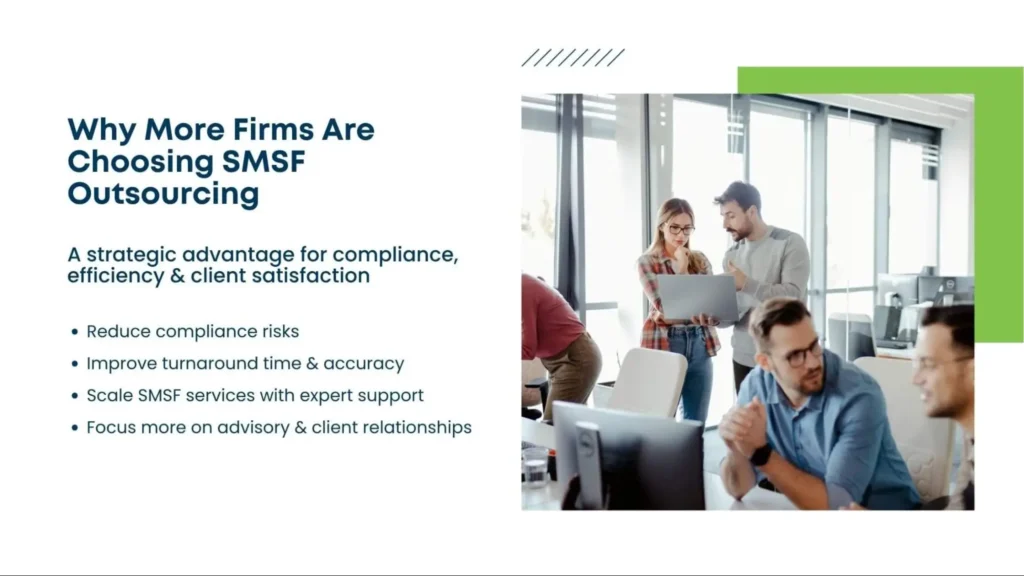
SMSF outsourcing has evolved into a strategic advantage for firms seeking efficiency, compliance, and client satisfaction. 

By partnering with trusted SMSF outsource services providers and the best SMSF administrators, accounting firms not only reduce operational burdens but also enhance service quality, scale smarter, and stay ahead of regulatory changes. 

As client expectations rise and compliance becomes more complex, SMSF outsourcing is no longer just a cost-saving option, it’s a future-ready pathway for firms aiming to grow sustainably and deliver superior value. To explore tailored SMSF support for your firm, contact our team.

6 Best Accounting Practice Management Software of 2025

Title slide showing the 6 best accounting practice management software solutions.

If you’re a bookkeeper, accountant, or managing an accounting firm, chances are you already rely on accounting software to keep your clients’ finances in order. You’ve built a solid client base through skill and dedication, and perhaps you’re even expanding your team with plans to scale further. 

At this stage, finding the best accounting practice management software isn’t just about convenience, it’s about setting the foundation for smarter workflows, better collaboration, and sustainable growth.

But with so many options on the market, what features truly matter when choosing a practice management software for accounting firms? You’re in the right place. NCS Australia specialise in helping accounting professionals identify the right tools to work smarter, not harder.

Key benefits of using accounting practice management software for firms.

Why Use Accounting Practice Management Software?

In today’s fast-evolving financial landscape, accounting practice management software is no longer a luxury, it’s a growth enabler for modern accounting firms. Beyond simplifying daily operations, it empowers professionals to work smarter and scale faster. Many firms also leverage outsourced bookkeeping services to complement their internal teams and ensure smooth operations.

The best accounting practice management software can:

  • Streamline workflows and improve operational efficiency
  • Reduce repetitive manual admin tasks
  • Enhance the client experience through faster, more accurate service
  • Boost profitability by freeing up valuable billable hours

By winning back time, accountants and bookkeepers can shift their focus from routine tasks to high-value activities like strategic planning, advisory services, and business development, the very elements that fuel sustainable firm growth.

List of the top 6 accounting practice management software tools for 2025.

6 Best Accounting Practice Management Software of 2025

In 2025, the best accounting practice management software does far more than track tasks; it streamlines workflow automation, time and billing, client collaboration, and performance analytics in one platform. 

As firms embrace hybrid work and cloud tools, choosing the right software has become a strategic decision. 

According to Accounting Today’s 2025 Technology Outlook, over 65% of firms adopting cloud-based accounting practice management software reported improved visibility into team capacity and project delivery times, proving that the right platform can transform efficiency and profitability.

For Australian accounting firms, solutions like Xero Practice Manager, MYOB Practice Manager, and Karbon provide robust workflow and client management tools that simplify daily operations and scale with your team. 

Below are six standout platforms shaping accounting operations in 2025.

1. Karbon

List of the top 6 accounting practice management software tools for 2025.

Karbon is renowned for its robust workflow automation and deep collaboration tools, making it ideal for firms that require structured processes and scalability.

Core strengths:

  • Shared inbox and email integration
  • Workflow templates with Kanban and calendar views
  • Automatic time tracking and client activity timelines
  • Powerful integrations with tax and accounting platforms

Pros:

  • Excellent team collaboration
  • Scalable for growing firms
  • High user satisfaction on review sites

Cons:

  • It can be complex for very small firms
  • Premium pricing for larger teams

Best for:
Mid-sized to large Australian firms prioritise teamwork, structured workflows, and accountability.

Integration:
Compatible with major accounting and tax software; highly rated for user experience.

2. Xero Practice Manager (XPM)

List of the top 6 accounting practice management software tools for 2025.

As an Australian-born company, Xero Practice Manager offers seamless integration with Xero’s accounting and payroll tools, making it a natural choice for firms already within the Xero ecosystem.

Core strengths:

  • Integrated client and job management
  • Simple time tracking and invoicing
  • Direct sync with Xero ledgers

Pros:

  • Easy integration for Xero users
  • Lightweight and intuitive interface

Cons:

  • Fewer advanced workflow features
  • Limited reporting customisation

Best for:
Australian firms that rely on Xero and prefer a unified, easy-to-manage platform.

Considerations:
Less feature-heavy than standalone practice management tools, but unbeatable for Xero users.

3. Financial Cents

List of the top 6 accounting practice management software tools for 2025.

Financial Cents is designed for Australian bookkeeping and accounting teams that value simplicity and fast onboarding. It offers an affordable, user-friendly solution that helps firms streamline client work and billing.

Core strengths:

  • Workflow and task management
  • Client communication and portals
  • Built-in billing automation

Pros:

  • Quick setup and intuitive interface
  • Affordable for small firms
  • Strong customer ratings

Cons:

  • Limited integrations compared to Karbon
  • Fewer enterprise features

Best for:

Small to mid-sized Australian firms that want structure without complexity.

Why pick it:

Highly rated on Capterra and G2, praised for usability and transparent pricing.

Firms managing self-managed super funds can also benefit from SMSF compliance services to streamline reporting, audits, and tax obligations, reducing risk while improving efficiency.

4. Jetpack Workflow

List of the top 6 accounting practice management software tools for 2025.

Why it stands out:

Jetpack Workflow focuses on repetitive accounting tasks, such as tax season prep and monthly bookkeeping, ensuring Australian teams never miss deadlines. Its intuitive design helps teams stay organised and efficient.

Core strengths:

  • Recurring project templates
  • Deadline and capacity tracking
  • Easy time logging

Pros:

  • Great for repetitive workflows
  • Easy to learn and use

Cons:

  • Minimal billing automation
  • Limited advanced reporting

Best for:

Australian firms with recurring engagements that need standardised processes.

Integration highlights:

Connects with major accounting software, offering structure without overcomplication.

Staying on top of regulations is critical. Financial compliance services can help accounting firms maintain compliance with ease, complementing workflow management software.

5. Uku

List of the top 6 accounting practice management software tools for 2025.

Uku is an emerging player in 2025, offering a modern interface and robust functionality for Australian accountants who want a balance between automation, reporting, and client experience.

Core strengths:

  • End-to-end workflows, CRM, and analytics
  • Comprehensive time & billing management
  • AI-driven insights and sleek UX

Pros:

  • Modern design and full functionality
  • Regularly featured in 2025 “best of” lists

Cons:

  • Less established than Karbon or Xero
  • Pricing may be high for small teams

Best for:

Australian firms are seeking an all-in-one, modern alternative to traditional practice management tools.

Market note:

Regularly featured in “Best Accounting Practice Software 2025” roundups for innovation and usability.

6. MYOB Practice Manager

List of the top 6 accounting practice management software tools for 2025.

MYOB Practice Manager is a popular choice among Australian accounting firms for managing projects, time, and client workflows all in one platform. It’s designed to streamline operations while integrating seamlessly with MYOB’s accounting software.

Core strengths:

  • Job and client management
  • Time tracking and invoicing
  • Integrated with MYOB accounting ledgers

Pros:

  • Smooth integration with the MYOB ecosystem
  • Efficient workflow and task management
  • Trusted by Australian accounting firms

Cons:

  • Less modern UX compared to some new entrants
  • Limited advanced reporting features

Best for:

  • Australian firms that already use MYOB Accounting and want an integrated workflow solution

Integration:

  • Works well with MYOB Accounting and Payroll, making it a complete solution for firms entrenched in the MYOB ecosystem

Conclusion

Choosing the best accounting practice management software or accounting firm workflow management software in 2025 is a strategic investment that can transform your firm’s efficiency, collaboration, and client service. 

Platforms like Xero Practice Manager, MYOB Practice Manager, Karbon, or Uku allow firms to automate repetitive tasks, streamline workflows, and focus on high-value advisory services. 

Leveraging these cloud-based accounting practice management software solutions enhances productivity and sets your firm up for sustainable success in a competitive market. 

Ready to explore the right solutions for your firm? Connect with us to discuss customized outsourcing and cloud-based accounting practice management software options for Australian accounting firms.

Convert MYOB to Xero: A Step-by-Step Migration Guide in 2025

Step-by-step guide to convert MYOB to Xero with visual of data analysis and financial graphs on a laptop.

Converting MYOB to Xero has become a strategic move for many Australian businesses aiming to enhance flexibility, automate processes, and gain real-time financial visibility. As digital accounting continues to evolve, more organisations are choosing to change from MYOB to Xero to simplify workflows and make data-driven decisions with confidence.

This guide unpacks why so many firms are transitioning, highlights the advantages Xero offers over traditional systems, and outlines the essential steps to ensure a smooth migration. Whether you’re still exploring options or ready to leap, in this article, NCS Australia provides practical insights to help you navigate the process and understand how it can transform your business operations.

MYOB vs Xero: A Quick Overview

When you compare Xero and MYOB, both provide robust accounting features, but their approaches differ. MYOB, developed in Australia, is trusted for its comprehensive financial tools and offline functionality for small and medium-sized businesses.

On the other hand, Xero, a cloud-based platform from New Zealand, is widely recognised for its intuitive interface, automation, and real-time reporting. Many businesses now evaluate this MYOB Xero comparison to see which system best supports growth, collaboration, and efficiency.

Before you convert MYOB to Xero, consider these key factors to ensure a successful migration:

  • Data Compatibility: Assess which historical data, transactions, and reports can be accurately migrated to Xero.
  • Integration Requirements: Identify the third-party apps and bank feeds currently used in MYOB and confirm their compatibility with Xero.
  • User Training: Ensure your team receives adequate training to understand Xero’s dashboard, reporting tools, and automation features.
  • Compliance and Accuracy: Verify that financial data aligns with Australian accounting and tax regulations post-migration.


  • Migration Partner: Choose a reliable migration tool or partner, such as Jet Convert MYOB to Xero, to streamline the process and minimise errors.
Key considerations before changing from MYOB to Xero, including cost analysis, features, and third-party integrations

What Australian Businesses Must Consider Before Migrating from MYOB to Xero

Before you convert MYOB to Xero, consider more than just the technical migration. The decision should factor in costs, features, integrations, and long-term usability to ensure your financial systems boost efficiency, visibility, and team productivity.

Here are the key considerations Australian businesses should evaluate before making the switch:

  • Cost Analysis: Review the pricing of both platforms, including subscriptions, add-ons, and setup costs. Xero’s 2025 small business plans range from AUD $33 to $85 per month, while MYOB often adds fees for payroll or advanced features. Consider whether Xero’s automation and efficiency gains justify the investment.
  • Features and Functionality: When comparing MYOB vs Xero, consider which best supports your operations. Xero offers automation, real-time bank feeds, and cloud collaboration, while MYOB is strong for offline access and legacy workflows. Understanding your team’s priorities ensures a smoother transition.
  • Reporting and Analytics: Strong financial decision-making relies on effective reporting. Compare both systems’ analytics to see how easily you can generate insights, track performance, and create custom dashboards. Xero’s live KPI tracking helps streamline strategic planning.
  • Integration with Third-Party Apps: Modern businesses need connected systems. Check if Xero integrates with your CRM, inventory, or payment platforms. With 1,000+ app integrations, it’s highly flexible for Australian SMEs.
  • User Experience: Assess how intuitive each platform is. A well-designed interface speeds up bookkeeping and reduces errors. Xero’s cloud-native design is praised for simplicity and ease of use, ideal for digital-first teams.

By assessing these critical areas, your organisation can make an informed decision that ensures not just a migration, but a long-term transformation in how your business manages finances and growth.

6 steps to seamlessly convert MYOB to Xero with detailed instructions for data export, import, and reconciliation.

6 Simple Steps to Migrate from MYOB to Xero

Migrating from MYOB to Xero doesn’t have to be daunting. With proper planning, the right tools, and a clear process, your business can transition smoothly while ensuring accuracy and compliance. 

A structured, step-by-step approach, from preparation to final reconciliation, is key to a successful migration. Here’s how to confidently convert MYOB to Xero in six simple steps.

1. Plan Ahead

Invest time in preparation. Identify the data to migrate contacts, invoices, payroll, and historical transactions and set a clear timeline. Planning early helps anticipate challenges and ensures a smooth transition without disrupting workflows.

2. Choose Your Migration Tool

Select the right tool for a seamless migration. Many businesses use Jet Convert MYOB to Xero, officially recommended by Xero, to automate data transfer. Alternatively, professional outsourced accounting providers can manage the process securely and accurately.

3. Export Data from MYOB

Export your chart of accounts, invoices, bills, payroll, and transaction history. This can be done via MYOB’s export function or by outsourcing experts to ensure completeness and accuracy.

4. Import Data into Xero

Upload your exported data into Xero, typically via CSV. Tools like Jet Convert can automate this step and reduce errors, ensuring your financials align with reporting dates for a clean start.

5. Set Up Xero Settings

Configure Xero to match your business operations, chart of accounts, tax rates, payment terms, user permissions, and invoice templates. Customisation ensures consistency while leveraging Xero’s automation and cloud flexibility.

6. Test and Reconcile

Review financial data, compare trial balances, and reconcile accounts. Running both systems in parallel briefly can catch discrepancies early, ensuring accuracy before fully operating in Xero.

A structured approach not only ensures a successful migration but also boosts long-term efficiency. According to Xero’s 2024 Small Business Insights, businesses that digitise and automate accounting save up to 10 hours per week on manual bookkeeping.

Helpful Tips for a Smooth Transition from MYOB to Xero

Successfully converting MYOB to Xero requires careful preparation and a thoughtful approach. By following best practices, businesses can minimise disruptions and make the transition as seamless as possible. Here are some key tips to ensure a smooth migration:

  • Gather Essential Data: Collect all relevant information, including employee and customer records, invoices, bank statements, and historical transactions, before starting the migration. Having complete and organised data will make the import process into Xero far more efficient.


  • Familiarise Yourself with Xero: Take time to explore Xero’s interface and features. Understanding how dashboards, reporting tools, and automation functions work will help your team navigate the system confidently once the data is migrated.


  • Start Small: Begin by transferring a limited set of data, such as a few months’ worth of transactions. This approach allows you to test the process, identify any errors, and make corrections without risking large volumes of information.


  • Exercise Patience: Adapting to a new accounting platform can feel challenging initially. Move methodically, provide training for your team, and allow a learning period to ensure a successful transition from MYOB to Xero.

By applying these strategies, businesses can achieve a smoother migration, minimise errors, and fully leverage Xero’s cloud-based capabilities for real-time financial insights.

Conclusion

Transitioning from MYOB to Xero is more than just moving data, it’s an opportunity for Australian businesses to enhance efficiency, automate workflows, and gain real-time financial insights. Careful planning, selecting the right migration tools such as Jet Convert MYOB to Xero, and following a structured approach ensure a smooth and accurate transition.

When you compare Xero and MYOB, Xero’s cloud-based platform, intuitive interface, and extensive integrations clearly stand out, making it an ideal choice for businesses seeking scalability and streamlined accounting processes. 

Understanding this MYOB Xero comparison allows organisations like NCS Australia to make informed decisions and confidently embrace the advantages of modern, digital accounting.