










Australian Outsourced Accounting for Nonprofits: 2026 Guide

Guide to outsourced accounting for nonprofits, featuring a professional working at a desk with financial documents and a calculator.

Nonprofits are the heart of our communities, tackling social challenges and providing vital services that make a lasting impact. Yet, managing their finances can be difficult, especially for organisations operating with limited budgets, evolving compliance obligations, and increased pressure for financial transparency.

This is where outsourced accounting for nonprofits becomes essential. By partnering with experienced accounting professionals, nonprofits can access expert financial management, advanced reporting tools, and consistent compliance oversight without the expense of a full in-house team. 

The right outsourced accounting partner ensures accuracy, accountability, and strategic financial guidance, allowing nonprofits to focus more on their mission and less on managing complex financial operations.

Key Takeaways

  • Outsourced accounting for nonprofits helps organisations manage complex financial, compliance, and reporting obligations without the cost of hiring a full in-house team.
  • Nonprofit-specific requirements such as fund accounting, multi-dimensional expense reporting, and donor-restricted fund management demand specialised expertise that outsourced partners are equipped to deliver.
  • With rising transparency expectations from donors, grantors, auditors, and regulators, outsourcing ensures stronger charity financial reporting, audit readiness, and consistent compliance.
  • The right outsourced accounting partner enables nonprofits to enhance financial accuracy, strengthen stakeholder trust, and redirect more resources toward mission-driven work.

What Makes Nonprofit Accounting Unique?

Before exploring the advantages of outsourced accounting for nonprofits, it’s essential to understand the distinct financial landscape these organisations operate in. 

Unlike for-profit entities driven by shareholder returns, nonprofits focus on maximising social impact and stewarding funds responsibly. They must balance mission delivery with strict transparency and accountability standards set by donors, grant agencies, and regulatory authorities. 

To maintain their tax-exempt status and ongoing public trust, nonprofits must comply with complex reporting and governance requirements, ensuring that every dollar is used ethically and effectively to advance their cause.
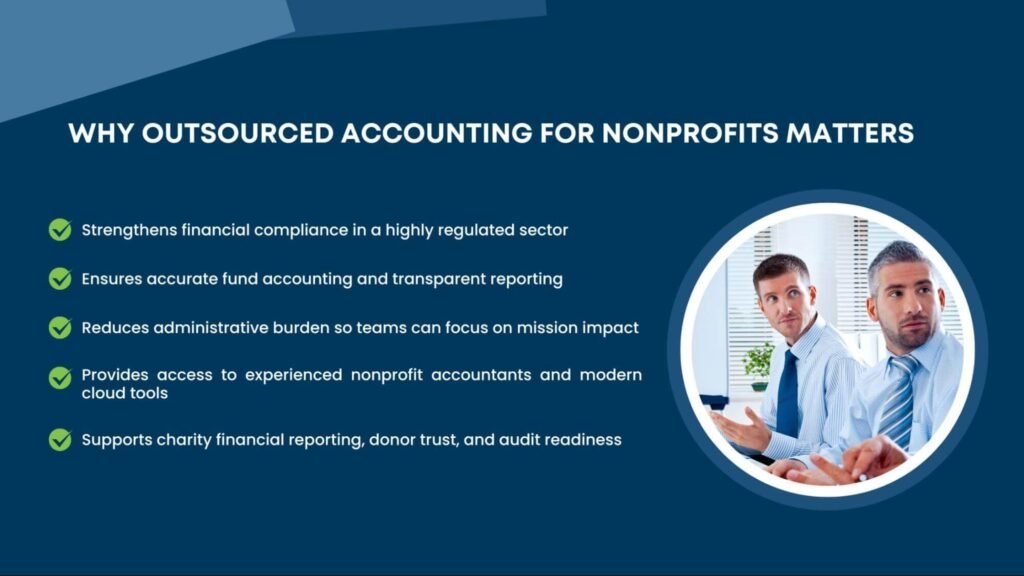
Benefits of outsourced accounting for nonprofits, with professionals collaborating on financial strategies for charity organizations.

Nonprofit Fund Accounting

Fund accounting is a cornerstone of outsourced accounting for nonprofits, ensuring transparency, accountability, and compliance in how financial resources are managed. Unlike traditional accounting, this approach focuses on tracking funds based on donor restrictions and specific program purposes rather than profit generation.

Key elements of fund accounting include:

  • Segregation of resources: Nonprofits divide funds into distinct categories such as unrestricted, temporarily restricted, and permanently restricted, based on donor or grantor requirements.
  • Accurate tracking: Each fund’s income, expenses, and net assets are recorded separately to maintain financial clarity and accountability.
  • Compliance and reporting: Fund accounting ensures adherence to unique charity financial reporting standards and legal obligations for restricted and unrestricted funds.
  • Transparency: Clear records demonstrate that all contributions are used in accordance with donor intent, strengthening public trust.
  • Practical example: A nonprofit may have a general operating fund for daily activities, a restricted fund for a specific grant project, and an endowment fund for long-term sustainability, all managed and reported on independently.

By adopting fund accounting practices, nonprofits can maintain financial integrity, meet reporting obligations, and strengthen stakeholder confidence in their mission-driven work.

Expense Reporting

Accurate expense tracking is a critical component of outsourced accounting for nonprofits, ensuring transparency, compliance, and data-driven decision-making. Nonprofits must often record and report the same expense in multiple ways to meet the needs of different stakeholders, funding bodies, and regulatory agencies.

Nonprofits typically track expenses:

  • By donor restriction or internal designation: To ensure funds are used according to donor intent or board-approved purposes.

  • By grant or major funding source: Many grants and contributions require detailed reporting to verify appropriate fund usage.

  • By functional category: Expenses are classified under programs, general and administrative, or fundraising activities for IRS Form 990 and financial statement reporting.

  • By natural category: Costs are further broken down by type, such as salaries, rent, utilities, travel, and supplies.

  • By department or location: Supports internal budgeting and performance tracking across programs or regions.

  • For indirect cost allocations: Helps distribute shared overhead expenses fairly across different functions or projects.

  • With statistical data and KPIs: Links financial reporting with measurable outcomes, demonstrating impact and accountability to the public.

Because nonprofits may need to classify the same dollar six or more ways, careful planning and a well-structured accounting system, often supported by a specialised accountant for charities, are essential for maintaining accuracy and compliance.
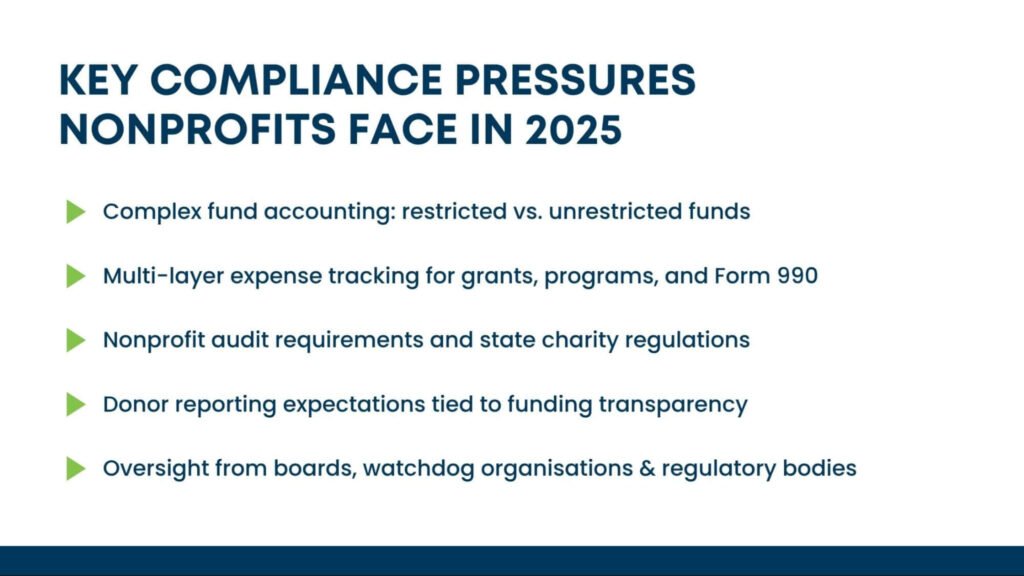
Key compliance pressures nonprofits face in 2025, including fund accounting, grant tracking, audit requirements, and donor reporting.

Compliance and Reporting Challenges

Compliance is one of the most demanding aspects of nonprofit financial management. With evolving regulations and diverse stakeholder expectations, maintaining transparency and accountability has become increasingly complex.

Nonprofits must comply with reporting requirements from multiple key stakeholders, including:

  • The Internal Revenue Service (IRS): To maintain tax-exempt status and ensure accurate completion of Form 990 and related filings.
  • State regulatory bodies: For charitable solicitation and fundraising compliance.
  • Donors and grantors: Who expect detailed charity financial reporting demonstrating fund utilisation and measurable program impact.
  • Board of directors: Responsible for governance, financial oversight, and strategic accountability.
  • Charity watchdog organisations: Such as Charity Navigator, GuideStar, CharityWatch, and BBB Wise Giving Alliance, which assess transparency and stewardship.

Meeting these diverse obligations requires deep knowledge of nonprofit accounting principles, tax laws, and reporting standards. 

For many smaller organisations, maintaining this expertise internally is resource-intensive, making nonprofit accounting outsourcing a cost-effective and compliant alternative.

Choosing the Right Outsourced Accounting Partner

Selecting the right provider for outsourced accounting for nonprofits is crucial to ensuring both financial efficiency and long-term compliance. 

The right partnership can empower your organisation to focus on its mission while maintaining transparency and control over its finances.

When evaluating potential partners, consider the following:

  • Nonprofit expertise: Choose firms with a proven track record in the nonprofit sector. For instance, BPM has served more than 500 nonprofit organisations over four decades, providing deep sector insight and practical experience.
  • Technology capabilities: Ensure they use modern, cloud-based tools such as QuickBooks, Sage Intacct, or NetSuite platforms well-suited to nonprofit accounting and reporting needs.
  • Customisation: Look for flexibility in services that can be tailored to your organisation’s structure, size, and financial complexity.
  • Communication style: Select a team that aligns with your preferred communication frequency and reporting approach.
  • Compliance knowledge: Confirm their understanding of nonprofit accounting standards, audit preparation, and relevant certifications like the AICPA Not-for-Profit Certificate.

Partnering with a firm like NCS Australia, a trusted outsourcing company offering comprehensive financial services compliance outsourcing, can help nonprofits enhance accuracy, strengthen compliance, and channel more resources toward community impact.

Conclusion

In 2025, outsourced accounting for nonprofits has become more than just a financial solution, it’s a strategic step toward sustainability, compliance, and transparency. 

As reporting standards grow more complex, outsourcing enables nonprofits to access specialised expertise and advanced tools that ensure accuracy and accountability in every financial decision.

By leveraging outsourced bookkeeping for nonprofits and reliable accounting packages for charities, organisations can simplify charity financial reporting, meet nonprofit audit requirements, and dedicate more time to their mission. 

A trusted accounting partner empowers nonprofits to strengthen governance, build donor confidence, and focus their energy where it matters most, creating lasting community impact.

Get to Know NCS Australia

Accurate, compliant, and affordable bookkeeping services for Australian businesses – managed by certified experts.

How to File Business Activity Statement (BAS) in 2025-26

Business professionals reviewing financial documents on a tablet for filing a Business Activity Statement (BAS).

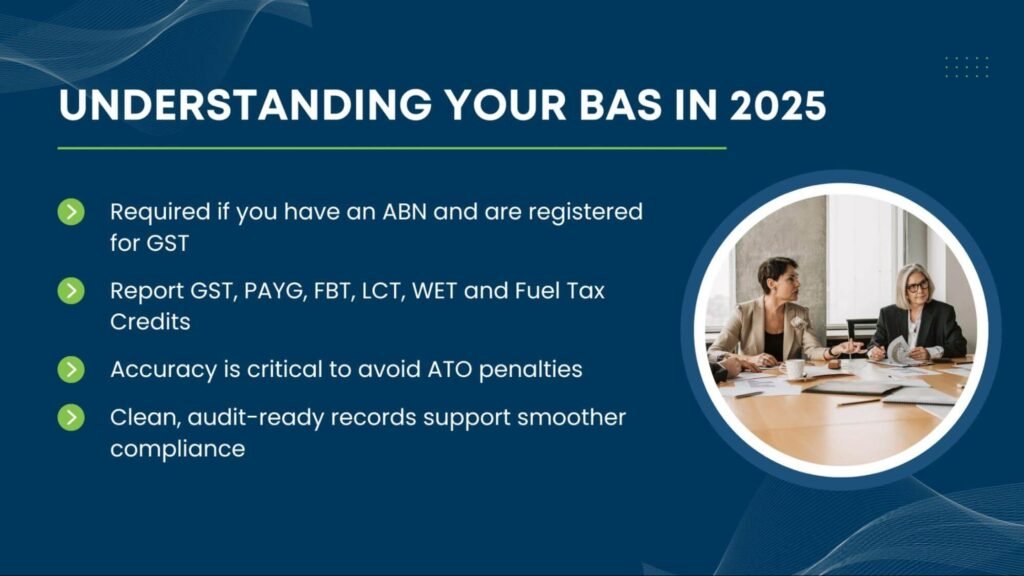
If your organisation has an ABN and is registered for GST, the ATO will automatically issue your Business Activity Statement for each reporting cycle, monthly or quarterly, depending on your requirements. Understanding how to file a business activity statement is essential for nonprofits in 2025, especially with strict accuracy standards and firm lodgement deadlines.

Even small errors can create delays, penalties, or compliance risks, making it crucial to maintain clean financial records and stay audit-ready. Whether your BAS is prepared internally or through an outsourced accounting partner, knowing the requirements supports smoother operations and allows you to focus more on community outcomes.

Key Takeaways

  • Understanding how to file a Business Activity Statement (BAS) is essential for nonprofits to maintain compliance, avoid penalties, and ensure accurate financial reporting.

  • Each BAS is customised based on your organisation’s GST status, PAYG obligations, and other tax registrations like FBT, LCT, WET, and Fuel Tax Credits.

  • Lodgement frequency, annual, quarterly, or monthly, depends on your turnover, making it important to track ATO BAS due dates to avoid missed deadlines.

  • Working with a registered BAS or tax agent helps reduce errors, improve compliance accuracy, and ensure smooth, stress-free lodgement.

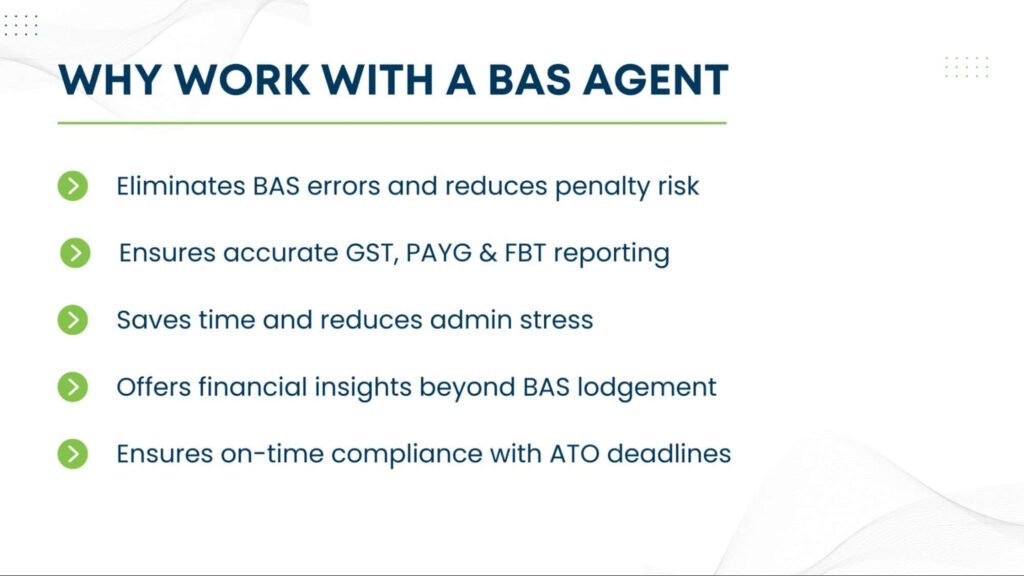
Bullet points explaining the advantages of working with a BAS agent for accurate GST and PAYG reporting.

Understanding Your Business Activity Statement: A Complete Compliance Guide

The Business Activity Statement (BAS) is not a generic tax form but a customised reporting tool designed to reflect your organisation’s specific financial activities. Understanding how to file a business activity statement helps you interpret this document clearly, ensuring you meet your obligations with accuracy and confidence. 

Your BAS will vary based on your size, structure, and tax registrations, making it essential to know which components apply to your operations and when to lodge business activity statement submissions to stay fully compliant.

Key Components You May Find on Your BAS:

  • Goods and Services Tax (GST)
  • Pay-As-You-Go (PAYG) Instalments
  • PAYG Withholding
  • Fringe Benefits Tax (FBT)
  • Wine Equalisation Tax (WET)
  • Luxury Car Tax (LCT)
  • Fuel Tax Credits (FTC)

Goods and Services Tax (GST)

GST is a 10% consumption tax applied to most goods and services sold or consumed in Australia. Organisations that exceed the $75,000 turnover threshold ($150,000 for nonprofits) must register for GST, while others may opt in voluntarily to improve transparency and claim credits. For many nonprofits, annual GST reporting is an option where eligible, simplifying compliance in a low-activity year.

Key GST obligations include:

  • Registering once your turnover exceeds the threshold
  • Charging 10% GST on taxable sales
  • Tracking all GST credits from business purchases
  • Keeping accurate GST records
  • Reporting GST collected and paid on your BAS

Pay-As-You-Go (PAYG)

PAYG helps organisations spread income tax payments throughout the year. It includes two components: instalments and withholding.

PAYG Instalments

These are periodic prepayments toward your expected annual tax. They:

  • Begin after your first profitable tax return
  • Offset your year-end tax liability
  • Are calculated based on your previous taxable income

PAYG Withholding

If you pay wages, you must register for PAYG withholding. You must:

  • Withhold the correct tax from employee salaries
  • Report gross wages and withheld tax on your BAS
  • Remit those amounts to the ATO

Fringe Benefits Tax (FBT)

Fringe Benefits Tax (FBT) is a separate tax paid by employers on non-cash benefits provided to employees in addition to their salary or wages. If your organisation offers perks such as company cars, entertainment, or expense reimbursements, any FBT payable for the reporting period must be included in your BAS. 

Although FBT is calculated independently from GST or income tax, businesses may still need to report instalments or their FBT liability through their BAS, making it essential to track and determine the taxable value of all fringe benefits provided.

Key points to remember about FBT:

  • Applies to non-cash benefits provided to employees
  • Calculated separately from income tax
  • Based on the taxable value of fringe benefits
  • Reported as part of your Business Activity Statement

For support in meeting complex compliance requirements across FBT and GST, many nonprofits partner with financial services compliance specialists.

Luxury Car Tax (LCT)

Luxury Car Tax (LCT) is a federal tax applied to the sale or importation of high-value vehicles that exceed the ATO’s annual luxury car threshold. 

While it mainly affects car dealers, importers, and individuals purchasing prestige vehicles, any business involved in selling or importing eligible cars must calculate and report LCT through their BAS.

The tax is only applied to the portion of the vehicle’s value that exceeds the set threshold, making accurate valuation and record-keeping essential for compliance.

Key points to know about LCT:

  • A 33% tax is applied to the value of a car above the luxury car threshold
  • Applies to licensed dealers and individual importers of luxury vehicles
  • 2023–24 thresholds: $89,332 for fuel-efficient vehicles and $76,950 for other vehicles
  • 2024–25 thresholds: $91,387 for fuel-efficient vehicles and $80,567 for other vehicles
  • Calculated only on the amount exceeding the threshold
  • Must be reported on the BAS when selling or importing eligible vehicles

Wine Equalisation Tax (WET)

  • Applies only to wine manufacturers, wholesalers, and importers
  • Tax rate: 29% of the value of the wine
  • Calculated and reported through your Business Activity Statement (BAS)
  • Requires detailed record-keeping of all wine sales and valuations

Fuel Tax Credits (FTC)

  • Available for machinery, heavy vehicles, and off-road business vehicles
  • Claimed as a credit on your BAS to offset fuel excise
  • Must calculate the eligible fuel used for business activities
  • Requires accurate documentation of fuel purchases, usage, and business purposes
Team meeting discussing GST and tax reporting requirements for BAS in 2025.

How Often Do I Need to Lodge My BAS?

If you’re registered for GST, you must lodge a BAS every reporting cycle, even if you have no activity.

Annual

  • For businesses under $75,000 turnover ($150,000 for nonprofits)

Quarterly

  • For organisations with a turnover under $20 million

Quarterly Due Dates:

  • Q1 (Jul–Sep): 28 October
  • Q2 (Oct–Dec): 28 February
  • Q3 (Jan–Mar): 28 April
  • Q4 (Apr–Jun): 28 July

Monthly

  • Required for turnover above $20 million
  • Due 21 days after the month-end

(Note: always check current ATO BAS lodgement dates, tax agent guidance if you use a registered agent to ensure agent-specific concessions are applied.)

How to File a Business Activity Statement

You can file your BAS through:

  • Your myGov account (sole traders and individuals)
  • ATO Online Services for Business
  • A registered BAS or tax agent, many organisations choose this route to lodge business activity statement submissions correctly and on time

When lodging yourself, accuracy is essential. You must calculate:

  • GST
  • PAYG withholding
  • PAYG instalments
  • Any additional taxes (FBT, FTC, LCT, etc.)

A single miscalculation can trigger ATO penalties.

How to prepare a BAS statement

Before lodging, gather:

  • Sales records
  • Purchase invoices
  • Payroll summaries
  • Reconciled bank statements

Why Use Professional BAS Support

Many nonprofits choose a registered BAS agent because professionals:

  • Detect errors you may miss
  • Interpret tax requirements correctly
  • Ensure on-time, accurate lodgement
  • Reduce penalty risk
  • Free your organisation’s time
  • Provide additional financial insights

Why ATO BAS Due Dates Matter for Your Business

Understanding your ATO BAS due dates is more than just ticking a compliance box, it’s essential for avoiding penalties, maintaining cash-flow stability, and ensuring your records remain accurate throughout the year. 

When you prepare BAS statements correctly and ahead of time, you give your business the financial visibility it needs to plan tax payments and manage expenses. 

Many businesses work with an ATO BAS lodgement dates tax agent to avoid confusion around quarterly and annual deadlines, especially when juggling payroll, GST, PAYG, and other tax obligations.

Conclusion

Lodging your BAS doesn’t have to be overwhelming. With the right preparation and clear understanding of your obligations, you can manage your Business Activity Statement with confidence and avoid unnecessary stress. 

And if you ever find the process too complex, working with a professional can make BAS lodgement smoother, more accurate, and fully aligned with your responsibilities. 

Whether you choose to lodge yourself or rely on expert support, staying proactive ensures your business remains compliant and on track with its financial goals, especially when keeping up with changing ATO BAS due dates.