















Accounts Receivable Automation vs Outsourcing: What’s Best for Your Business?
- Aesha Shah
- November 27, 2025
- 4 minutes
- Accounts Outsourcing
Persistent payment delays and manual invoicing continue to burden finance teams, with 81% of companies reporting late payments and 73% attributing them to invoice-related issues. These inefficiencies weaken cash flow, strain customer relationships, and slow organisational growth, pressures that intensify amid inflation, tighter margins, and ongoing finance talent shortages.
As businesses push for financial stability, modernising the AR function is no longer optional. Understanding the difference between accounts receivable automation vs outsourcing has become essential for leaders aiming to strengthen collections and reduce operational friction.
Against this backdrop, outsourcing organisations are evaluating how accounts receivable automation can enhance internal processes and how outsourcing can provide specialised support without expanding headcount.
Automation strengthens accuracy and visibility within the accounts receivable process, while outsourcing offers scalability and expertise for teams lacking capacity. This article explores both approaches, outlines when each is most effective, and provides practical insights to help you build a resilient and growth-ready AR function.
What Is the Difference Between Accounts Receivable Automation and Outsourcing?
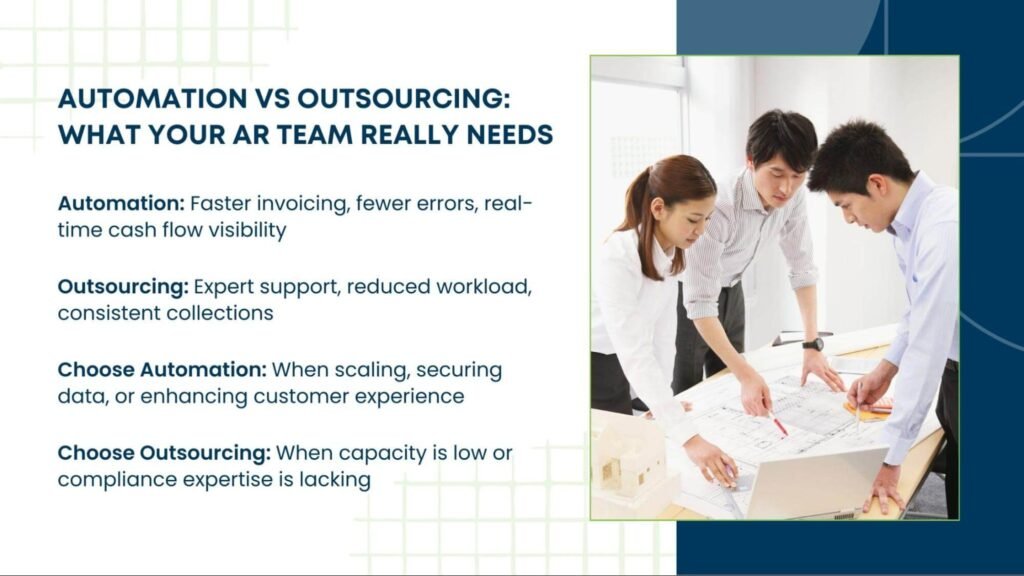
Before comparing accounts receivable automation vs outsourcing, here’s a point-wise breakdown of how both approaches differ:
Accounts Receivable (AR) Automation
- Uses software to manage tasks such as invoice creation, reminders, tracking, and reconciliation.
- Eliminates manual errors and accelerates the collections cycle.
- Forms a key part of the broader AR framework, ensuring timely and accurate payments.
- Provides real-time dashboards, analytics, and ERP integrations for improved visibility.
- Helps finance teams function efficiently without increasing headcount, supported by modern AR automation software and automated accounts receivable software.
Accounts Receivable (AR) Outsourcing
- Delegates part or all of AR operations to a specialised third-party or BPO provider.
- Outsourcing teams handle invoicing, collections, follow-ups, dispute resolution, and customer communication.
- Offers immediate access to skilled professionals when internal bandwidth is limited.
- Allows internal finance teams to focus on higher-value priorities.
- Often selected to reduce workload, increase efficiency, and gain specialised expertise in outsourcing accounts receivable operations.
When to Choose Outsourcing in Accounts Receivable
1. Small AR Departments With Limited Staff
If your AR team has 5–10 members managing invoicing, collections, reporting, and customer communication simultaneously, workloads can overwhelm them. Errors increase, follow-ups get delayed, and cash flow weakens.
Outsourcing routine tasks ensures timely collections while allowing your internal team to focus on strategic finance initiatives.
2. Limited In-House Compliance Expertise
Compliance is central to effective accounts receivable management, particularly under SOX, GDPR, and payment-security frameworks. Many teams lack the resources to keep up with evolving requirements.
An outsourcing partner offers trained experts who maintain strict compliance, strengthen audit readiness, and reduce operational and reputational risks.
3. Frequent Reallocation of Finance Staff
Growing organisations often reassign finance staff to FP&A or budgeting, leaving AR unsupported. This disrupts collections and leads to missed follow-ups.
With outsourcing, you ensure continuity and accuracy in daily AR functions, while freeing internal resources for strategic work.
4. When Testing AR Processes Before Scaling
If you’re not ready to invest in technology or expand your AR team, outsourcing acts as a strategic pilot.
It helps you analyse volumes, identify bottlenecks, and determine long-term requirements, without major upfront commitments.
When to Choose Automation in Accounts Receivable
1. When You Want AR to Become a Strategic Business Driver
Traditional AR is reactive, fixing issues after they occur. Automation transforms AR into a proactive, insight-driven function that influences financial planning and enhances customer experience.
Real-time data, predictive analytics, and customer-friendly tools help accelerate payments, reduce disputes, and strengthen long-term growth.
2. When You Need Greater Visibility Into Cash Flow
Manual processes and spreadsheets often leave finance leaders blind to real-time cash positions.
Automation integrates with your ERP and provides dashboards showing ageing reports, payment trends, and exception alerts, empowering faster, data-backed decision-making.
3. When Data Privacy and Confidentiality Are Crucial
Industries like healthcare, SaaS, and financial services deal with sensitive customer data.
Automation keeps information within your internal environment and supports PCI-DSS compliance, enabling secure payment processing and full audit traceability, without involving third-party platforms.
4. When You Want to Scale AR Operations Efficiently
As transaction volumes increase, manual workflows break down. Hiring more staff isn’t always sustainable.
Automation allows your team to manage thousands of invoices and reconciliations with high accuracy. Leading accounts receivable automation software helps scale operations without increasing headcount.
Tips to Enhance Your Accounts Receivable Management
Strengthening your accounts receivable management system is essential for predictable cash flow and a healthier customer experience. Implement these best practices:
- Define Payment Terms Clearly: Set expectations upfront to avoid disputes and delays.
- Send Accurate Invoices Promptly: Prevent payment interruptions with error-free invoicing.
- Classify Customers by Payment Behaviour: Tailor follow-up strategies to each customer segment.
- Automate Payment Reminders: Reduce manual work and accelerate collections.
- Simplify Payment Options: Offer multiple, convenient payment methods to improve on-time payments.
- Track Key AR Metrics Regularly: Monitor DSO, ageing, and trends to detect risks early.
- Align Sales and Finance: Improve collaboration to resolve disputes and ensure consistent customer communication.
Conclusion
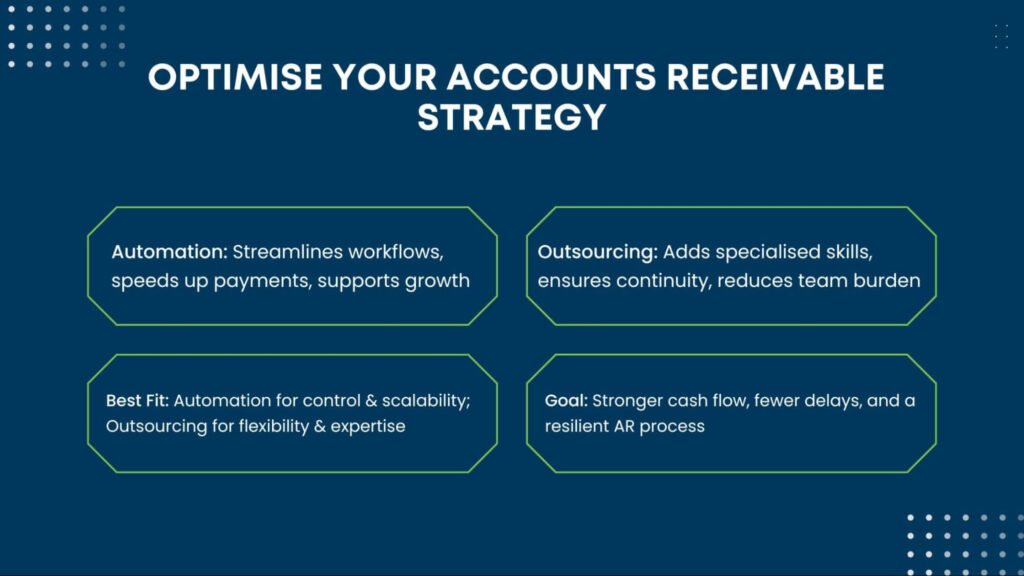
Deciding between accounts receivable automation vs outsourcing depends on your business goals, internal capabilities, and the role you want AR to play in future growth.
Automation delivers visibility, accuracy, and scalability, making it ideal for organisations aiming to modernise their accounts receivable process and elevate AR into a strategic function. It enhances customer experience, reduces errors, and empowers data-driven financial planning.
Outsourcing, on the other hand, provides access to specialised talent and operational support, especially valuable for lean or overloaded teams. Many organisations find the best results in a hybrid approach that blends automation technology with outsourced expertise.
Whatever you choose, your AR strategy should strengthen cash-flow predictability, reduce DSO, and support more confident financial decision-making.