










Guide to Outsourced Accounting and Its Benefits in Australia

Guide to outsourced accounting and its benefits in Australia with professionals discussing at a meeting.

In today’s evolving business environment, many organisations are turning to outsourced accounting as a smarter, more cost-effective way to manage their finances. Instead of maintaining large in-house teams, businesses are leveraging specialised providers who combine advanced technology with financial expertise.

This shift not only reduces operational costs but also gives leaders access to accurate, real-time insights that support better decision-making.

With remote work and digital platforms becoming the new normal, outsourcing has gained even greater momentum in Australia. Recent surveys by CPA Australia highlight that more than 60% of firms are adopting technology-driven accounting solutions to stay competitive.

In this guide, we’ll explore what outsourced accounting services really mean, the advantages they offer, and the types of businesses best positioned to benefit from this approach.

What is Outsourced Accounting?

Accounting service outsourcing, also called outsourced accounting, is when a business hires a specialised third party to handle the accounting and finance functions of the organisation. Instead of relying solely on internal staff, businesses partner with professionals who bring expertise, advanced systems, and scalable support customised to their needs.

These outsourced accountants can oversee a wide range of financial responsibilities, including bookkeeping, payroll processing, preparation of financial reports, management accounting, tax compliance, accounts payable and receivable, debtor follow-ups, and other critical finance-related tasks. 

By adopting this model, organisations gain access to the same level of accuracy and professionalism as an in-house team, often at a fraction of the cost, while freeing up internal resources to focus on growth and strategy.
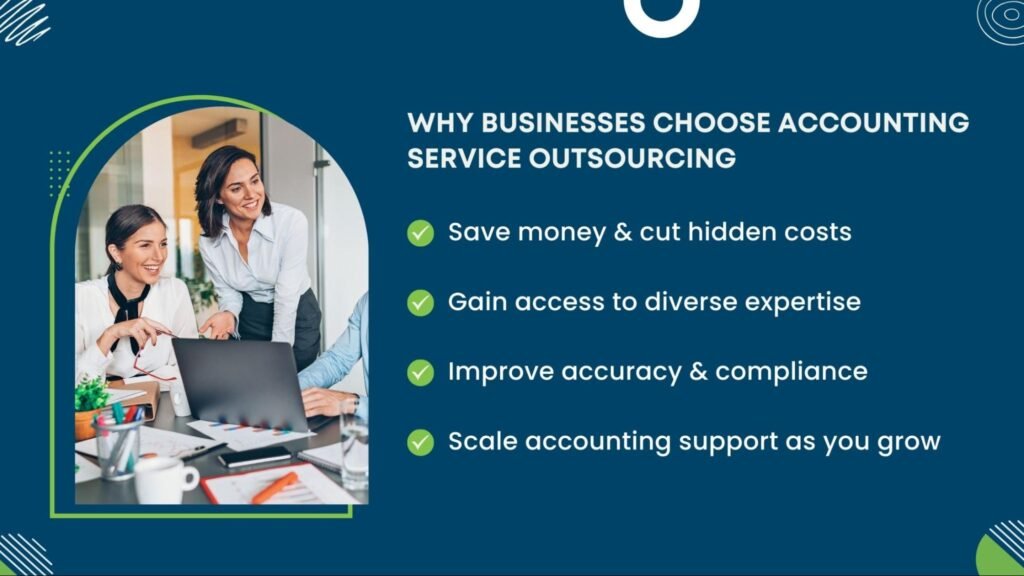
Why businesses choose accounting service outsourcing, highlighting cost savings, expertise, accuracy, and scalability.

What Are the Benefits of Outsourced Accounting?

Partnering with an outsourced accounting firm offers significant advantages. The outsourcing of accounting services not only reduces costs but also gives businesses access to skilled professionals and advanced tools that would otherwise be expensive to maintain in-house.

By leveraging specialist support, companies can strengthen financial accuracy, reduce risks, and free up resources to focus on growth opportunities.

Key Benefits of Outsourced Accounting

Save Money
Outsourcing accounting work is significantly more cost-effective than hiring a full in-house team. Instead of shouldering the overheads of staff and infrastructure, businesses can channel resources directly into growth.

  • Save on major costs including salaries, superannuation, office rent, and insurance.
  • Eliminate costs related to recruitment, onboarding, and training.
  • Only pay for the accounting services you need, exactly when you need them.
  • Gain access to a team with a wider skill set than a single employee could provide.

Access Expertise
Through accountant outsourcing, organisations can tap into the knowledge of specialists with advanced skills across multiple areas of finance. This ensures accuracy, compliance, and reliable reporting.

  • Certified professionals manage tax, payroll, bookkeeping, and compliance.
  • Reduce the risk of errors that may lead to costly penalties.
  • Benefit from industry best practices and up-to-date knowledge.
  • Access insights and advice that support strategic decision-making.

Save Time
Delegating financial responsibilities allows business leaders to focus on what truly matters, innovation and growth. With outsourced professionals managing the details, operations become more streamlined.

  • Spend less time managing accounts and financial reports.
  • Free up management bandwidth for business development.
  • Ensure timely board reports and financial presentations.
  • Reduce stress around compliance and regulatory deadlines.

Improve Productivity
Outsourced accountancy services empower businesses with reliable reporting and actionable insights. With a dedicated team handling finance, productivity across the organisation naturally improves.

  • Access real-time financial insights for better decisions.
  • Improve cash flow management and budgeting accuracy.
  • Streamline internal processes through automation and efficiency.
  • Enjoy peace of mind knowing all compliance and accounting tasks are covered
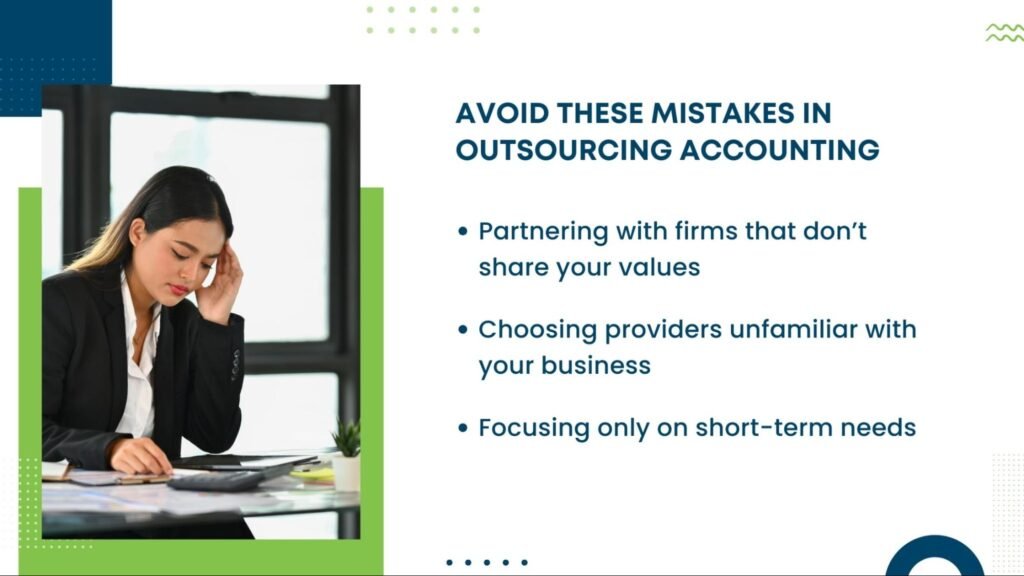
Mistakes to avoid in outsourcing accounting such as choosing the wrong firm, lack of business knowledge, and focusing only on short-term needs.

Common Mistakes People Make When Outsourcing

While outsourcing accounting work delivers significant benefits, businesses often fall into common traps when selecting a partner. Being aware of these mistakes can help organisations make better choices and build long-term, successful relationships with their providers.

  1. Choosing a Firm with Unaligned Values
    • Outsourcing is a partnership, not just a transaction.
    • If the provider’s values don’t align with yours, collaboration will be limited.
    • Shared vision and principles create trust and long-term success.
    • Always choose a firm that understands your goals and culture.
  1. Selecting a Provider Who Doesn’t Understand Your Business
    • Some providers focus only on completing tasks without context.
    • Lack of understanding can lead to missed insights and poor decisions.
    • A strong outsourcing partner will analyse your industry to provide customised solutions.
    • customised solutions go beyond compliance and support real growth.
  1. Focusing Only on Cost Instead of Quality
    • Cost savings are important but shouldn’t be the only factor.
    • The cheapest option may lack expertise, tools, or reliability.
    • Poor-quality service can lead to compliance risks and hidden costs.
    • Prioritise value, expertise, and scalability over price alone.

What to Do Before You Hire an Outsourced Accountant

Before engaging in financial accounting outsourcing, it’s essential to clearly define what you expect from the partnership. Too often, businesses rush into outsourcing without identifying their priorities, which can lead to mismatched expectations. A thoughtful approach ensures you choose the right provider and maximise the value of the relationship.

Steps to Take Before Hiring an Outsourced Accountant:

  1. Identify the Services You Need
    • List the accounting functions you want to outsource, such as bookkeeping, payroll, tax compliance, reporting, or transaction monitoring.
    • Be clear on whether you need full-service support or only specific functions.
    • Prioritise areas that consume the most time or create the biggest challenges in-house.
    • Ensure the provider you select has proven expertise in these areas.
  2. Clarify Your Business Goals
    • Go beyond tasks and define what outcomes you want to achieve.
    • Examples include improving cash flow, increasing efficiency, or gaining real-time visibility into your finances.
    • A strong outsourcing plan looks beyond short-term fixes and supports long-term growth.
    • Communicate these goals clearly so your provider can customise solutions.
  3. Assess Technology and Tools
    • Ensure the outsourced accountancy services, including payables outsourcing and other financial functions, use modern, cloud-based tools like Xero or MYOB.

    • Check that reporting systems are accessible, transparent, and secure.
    • Confirm that automation and digital processes are part of their offering.
    • Look for providers who can integrate efficiently with your existing systems.
  4. Evaluate the Partnership Fit
    • Choose a firm that understands your business and industry.
    • Check if their values and communication style align with yours.
    • Ask about their process for tailoring services to individual needs.
    • Prioritise firms that offer flexibility and proactive advice, not just task completion.

Conclusion

In an era where efficiency and accuracy define business success, outsourced accounting has become more than a cost-saving tactic, it’s a strategic move. By leveraging the expertise of specialised providers, businesses in Australia can streamline financial operations, ensure compliance, and access the latest digital tools, all while focusing their energy on innovation and growth.

Outsourcing empowers leaders to reduce risks, scale with confidence, and gain clear visibility into their financial health. As organisations continue to adapt to digital transformation and remote collaboration, the value of outsourcing accounting services will only grow stronger.

Whether it’s saving money, improving productivity, or achieving long-term financial clarity, partnering with the right outsourced accounting team can make the difference between simply managing numbers and driving meaningful business outcomes.

How Offshore Accountant Services Can Transform Your Firm

How offshore accountant services can transform your firm – professional accountant working on financial reports with calculator and documents.

The financial landscape has shifted dramatically since the global pandemic, pushing businesses to rethink how they manage core operations. One of the most impactful changes has been the rise of the offshore accountant as a strategic partner. 

By offshoring accounting processes, companies streamline operations, reduce overhead, and access highly skilled professionals at a fraction of local costs.

For many firms, the decision to hire offshore accountants is no longer just about savings, it’s about gaining access to reliable offshore partners who bring both technical expertise and scalability.

Understanding what is an offshore accountant and how these services work can be a turning point for firms seeking both efficiency and resilience. In this blog, we’ll explore the benefits of offshore accounting, the industries that stand to gain the most, and how adopting offshore solutions can strengthen decision-making while positioning your business for long-term success.

Key Takeaways

  • Australian firms are leveraging offshore accountants for bookkeeping, payroll, and compliance, gaining skilled professionals at a fraction of local costs.
  • Offshoring can cut overheads by up to 60%, freeing capital for growth and stronger financial controls.
  • Offshore accounting services provide detailed reporting and insights that support smarter planning and budgeting.
  • Tech-driven offshore bookkeeping services deliver automation, real-time access, and seamless collaboration.
  • India, Vietnam, the Philippines, Sri Lanka, and Malaysia remain top destinations for offshore accounting talent.

Offshore Accounting: An Overview

Offshore accounting services enable businesses to delegate bookkeeping, payroll, BAS preparation, reporting, and compliance to skilled professionals abroad, delivering quality work at significantly lower costs than local hiring. For Australian firms, partnering with an offshore accountant ensures compliance with global standards like IFRS and AASB while overcoming talent shortages and rising wage pressures.

Key advantages include:

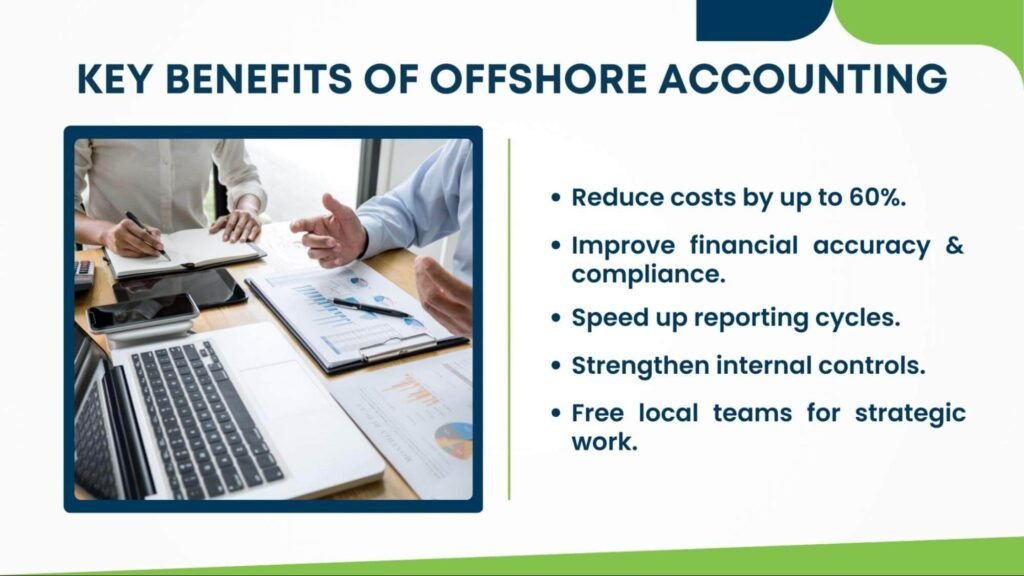
  • Cost savings of up to 60% on overheads, freeing capital for reinvestment.
  • India offers access to a vast pool of highly trained accounting professionals, including one of the world’s largest networks of Chartered Accountants and finance graduates.
  • Stronger internal controls and faster reporting cycles.
  • Reduced local hiring burden and training expenses.
  • Allowing in-house teams to focus on strategy and growth.
Key benefits of offshore accounting – reduce costs by up to 60%, improve financial accuracy and compliance, speed up reporting cycles, strengthen internal controls, and free local teams for strategic work.

How Can Offshore Accounting Firms Help You?

Partnering with an offshore accountant gives businesses cost-effective access to skilled professionals who manage bookkeeping, payroll, tax compliance, SMSF and reporting. By leveraging global talent, firms improve accuracy, meet international standards, and scale without the overhead of expanding in-house finance teams.

Key ways offshore accounting firms add value include:

  • Cutting Costs Efficiently: Save up to 60% on accounting operations by avoiding expenses tied to salaries, benefits, office space, and technology. Offshore firms deliver high-quality services at a fraction of local costs.
  • Access to Skilled Professionals: Offshore accountants are trained in standards like AASB, IFRS, GAAP, and HMRC, often holding global certifications such as CPA, ACCA, or CA.
  • Stronger Cash Flow Management: Accurate books, timely payments, and receivables tracking create predictable cash flow cycles and ensure sufficient liquidity for growth.
  • In-depth Financial Reporting: Offshore accounting services, including CFO accounting services, provide customised KPI dashboards and profitability analysis, empowering better planning and strategic decisions.
  • Tech-Driven Solutions: Using platforms like Xero, Zoho, QuickBooks, and NetSuite, offshore bookkeeping services automate tasks, reduce errors, and provide real-time access to financial data.
  • Scalable Resources: Flexible models let you outsource anything from monthly bookkeeping to virtual CFO services, adjusting easily as your firm grows.
  • Round-the-Clock Operations: With teams across time zones, tasks are completed overnight, shortening turnaround times and keeping business operations seamless.

Common Offshore Accounting Challenges Faced by Businesses

While working with an offshore accountant offers cost savings and access to global expertise, it also comes with challenges that firms must address proactively. Being aware of these hurdles allows businesses to plan better, safeguard compliance, and build stronger offshore partnerships.

Key challenges include:

  • Cybersecurity Risks: Sharing financial data with offshore teams can expose businesses to potential breaches if providers lack robust protections like encryption, two-factor authentication, and routine security audits.
  • Language and Cultural Barriers: Differences in communication styles, accents, and workplace culture may cause misunderstandings. Sensitivity training, SOPs, and clear documentation help bridge these gaps.
  • Unclear Goals and Expectations: Offshore projects often fail when roles, deliverables, and KPIs aren’t clearly defined. Strong onboarding, detailed workflows, and regular progress reviews are essential.
  • Regulatory and Compliance Issues: Offshore teams must understand local requirements such as BAS lodgement and ATO reporting, as well as international frameworks like IFRS, GAAP, and HMRC guidelines, to prevent compliance risks.
  • Quality Control and Oversight: Distance makes monitoring more complex. Without review systems, dashboards, and real-time communication, small errors can escalate. Internal controls and automation ensure accountability.

A Step-by-Step Guide to Building Your Offshore Accounting Team

Building an offshore accounting team allows businesses to cut costs, improve efficiency, and tap into a vast pool of global financial expertise. With the right planning, even small and mid-sized firms can build a reliable team that delivers round-the-clock financial support without the overhead of hiring in-house.

Steps to build a successful offshore team:

  • Set Clear Goals and Requirements: Define your offshoring objectives, whether it’s cutting costs, managing seasonal workload spikes, or enhancing efficiency. Identify specific functions like bookkeeping, accounts payable, payroll, or tax filing.
  • Select the Right Offshore Provider: Research firms with proven expertise, strong client portfolios, and familiarity with your country’s accounting standards. This ensures accurate, compliant, and high-quality delivery.
  • Implement Strong Communication Protocols: Use tools like Zoom for weekly reviews, Slack for daily updates, and task managers like Asana or Trello. Define clear reporting guidelines, turnaround times, and feedback processes.
  • Equip with Essential Tech and Infrastructure: Provide access to cloud-based tools like Xero, QuickBooks Online, or NetSuite. Secure collaboration with VPNs and multi-factor authentication, and ensure system integration to prevent delays or duplication.

Train and Onboard Your Offshore Team: Align offshore staff with your workflows, SOPs, and compliance policies. Use video training, live sessions, and structured onboarding to build long-term accuracy and efficiency.

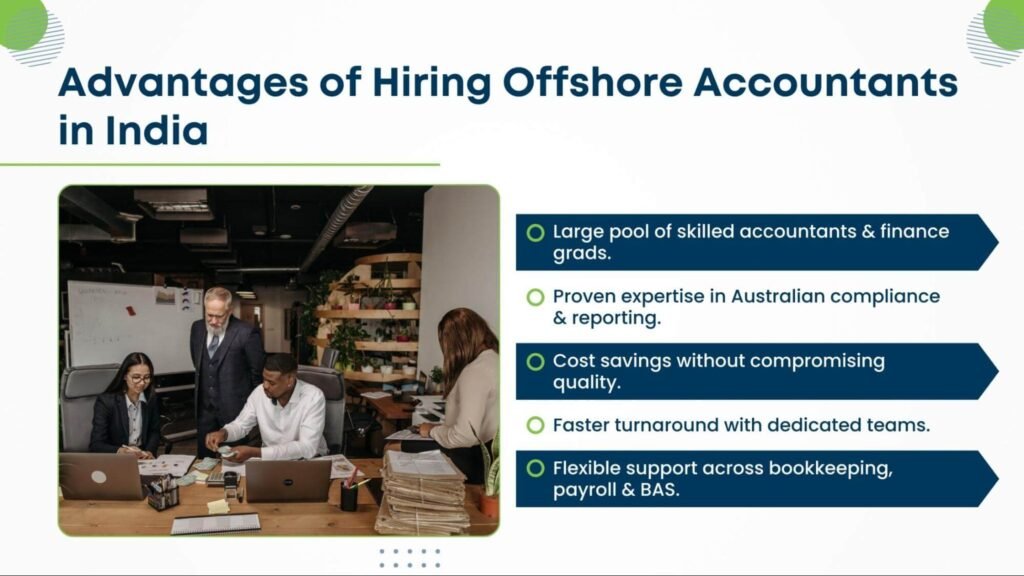
Advantages of hiring offshore accountants in India – large pool of skilled finance graduates, expertise in Australian compliance, cost savings, faster turnaround, and flexible support for bookkeeping, payroll, and BAS.

Best Country to Set Up Your Offshore Accounting Team

When it comes to offshore accounting services, India consistently ranks as the top choice for Australian businesses. With a vast pool of finance planning professionals, cost efficiency, and strong regulatory frameworks, India has become the go-to hub for global companies seeking reliable offshore accounting support.

Why India Leads in Offshore Accounting:

  • Unmatched Talent Pool: Over 400,000 Chartered Accountants and nearly 985,000 students enrolled in CA programs by 2025 ensure a steady pipeline of skilled professionals.
  • Global Standards: Accountants are well-trained in IFRS and AASB guidelines, ensuring compliance with international reporting requirements.
  • Cost Savings: Businesses can save up to 60% on overheads, freeing resources for growth and innovation.
  • Strong Infrastructure: A mature outsourcing ecosystem and advanced IT capabilities support seamless operations.
  • Strategic Value: Offshore accountants in India go beyond bookkeeping, delivering financial insights that enhance decision-making and business resilience.

With its unmatched talent pool, India remains the top destination for businesses looking to hire offshore accountants who are well-versed in international financial reporting standards.

Conclusion

Offshore accounting services give businesses the ability to lower costs, improve accuracy, and strengthen compliance with global standards. By accessing skilled professionals in cost-efficient markets like India, companies can achieve greater flexibility, scalability, and operational efficiency. This shift allows in-house teams to dedicate more time to strategic initiatives and business growth rather than routine financial tasks.

That said, the true success of offshoring lies in choosing the right partner. An experienced, versatile, and credible provider of offshore accounting services ensures not just smooth operations but also long-term value creation. With the right collaboration, businesses can unlock the full potential of outsourcing while safeguarding accuracy, compliance, and trust.